Saturday, March 12, 2011

"Perchance to Dream" by Jonathan Franzen in Harper's Magazine

In his now famous essay "Perchance to Dream: In an Age of Images, a Reason to Write Novels," published by Harper's Magazine in April, 1996, Jonathan Franzen unwittingly laid out a template for his soon-to-appear 3rd novel, The Corrections. Anticipating my blog post on that "substantive" novel, I am making some comments that provide context to that literary tour de force. It is ironic that the focus of this 20-page essay was a return to tragic realism in the spirit of novelists like Charles Dickens and Upton Sinclair. In effect, Franzen would depart from his first two postmodern-style novels ("no-mo Mr. po-mo") adopting a writing style based on minute detail and realism. The phrase "perchance to dream" is from Hamlet's 'to be or not to be' soliloquy.

Franzen grew up on a steady diet of great literature. "I was in love with literature and with a woman to whom I'd been attracted in part because she was a brilliant reader" (italics mine !). He recounts his disappointment with the reception of his first 2 novels, "the failure of my culturally engaged novel to engage with the culture. I'd intended to provoke; what I got instead was sixty reviews in a vacuum." He pokes fun at a radio announcer who "brushed at the novel's pages as though he hoped to absorb the plot transdermally." He mourns the ascendancy of television and the Internet and belatedly recognizes that "the dollar is now the yardstick of cultural authority." He remarks on the "incompatibility of the slow work of reading and the hyperkinesis of modern life." Great novels are also incompatible with the consumer economy: "The consumer economy loves a product that sells at a premium, wears out quickly or is susceptible to regular improvement, and offers with each improvement some marginal gain in usefulness. To an economy like this, news that stays news is nor merely an inferior product, it's an antithetical product. A classic work of literature is inexpensive, infinitely reusable, and, worst of all, unimprovable."

Franzen writes "At the heart of my despair about the novel had been a conflict between my feeling that I should Address the Culture and Bring News to the Mainstream, and my desire to write about the things closest to me, to lose myself in the characters and locales I loved....How was I going to satirize Internet boosterism and the Dow Jones as well while leaving room for the complexities of character and locale ?...How can you achieve topical "relevance"without drawing on an up-to-the-minute vocabulary of icons and attitudes and thereby, far from challenging the hegemony of overnight obsolescence, confirming and furthering it ?...Exspecting a novel to bear the weight of our whole disturbed society - to help solve our contemporary problems - seems to me a peculiarly American delusion."

With the publication of The Corrections he was able to do both in the "tragic realism" tradition of "Upton Sinclair and Harriet Beecher Stowe." Franzen opines "tragic realism preserves the recognition that improvement always comes at a cost." While Sinclair was bringing news to the public about atrocious worker conditions, Franzen adopted the same style, and applied it to a farcical situation to report on the trials and tribulations of an upper middle class family, whose life challenges revolved around job satisfaction, marital happiness, meaningful lives, rather than basic survival.

Sunday, February 27, 2011

Herzog by Saul Bellow


Herzog (1964) is an epistolary novel - a large portion of the text consists of letters written by the protagonist Moses Elkanah Herzog, most of which he never sends. The dense and cerebral novel is a tour de force, rich with intellectual heft, intertextuality and lyrical metaphor. The 47-year old Herzog, a college professor, is emerging from a painful second divorce, has lost custody of children from each marriage, and is searching for meaning in his life. The book covers a "five" (p. 326)-day period in his life, beginning in Ludeyville in the Berkshires. Don't go looking because "Ludeyville isn't on the map" (p. 329). The book is rich with allusions, but be forewarned that the reference to Moses Herzog in Joyce's Ulysses' Cyclops chapter is a red herring for over-eager students of allusions. To fully appreciate the novel, some basic understanding of Kierkegaard and Hegel is insightful. We'll get to that.


His itinerary is summarized on the opening page: "He had carried this valise from New York to Martha's Vineyard, but returned from the Vineyard immediately; two days later he flew to Chicago, and from Chicago he went to a village in western Massachusetts" (p. 1), the valise filled with letters. Herzog yearns to be a "berimmter mensch" (p. 61) but is your basic schlemiel: "Considering his entire life, he realized that he had mismanaged everything - everything" (p. 3). In the opening line of the novel he relates in a flashback: If I am out of my mind, it's all right with me" (pp. 1, repeated on 315). The re-reader will remember the line is repeated at the end of the novel in real time. In the telling of the story, Herzog shifts from 1st person to 3rd person to detach himself from his painful acknowledgement of his failings. Moses' ability to alienate himself (in the 3rd person) is dubbed "doublethink" by Kiernan (Saul Bellow). These modulated shifts in point of view occur frequently in the text. He can maintain equipoise by being a detached witness to his perceptions: "I am a prisoner of perception, a compulsory witness" (p. 72).


Everyone in his life takes pleasure in abusing him. As a young man, his father came after Moses with a pistol in response to his asking for money (p. 248). Moses would contemplate using that same pistol years later to murder his 2nd wife and her lover (pp. 252-255). He was even sexually abused, but kept that to himself all his life (p. 288). When this loser is with his daughter in Chicago, he has an accident in his rental car and gets busted with a loaded pistol and no permit (p. 281).


It is useful to examine the details of the contemplated murder as it is the climactic scene of the book. Granted, Moses spends most of the book physically inert, doing all his thinking. His ex-wife Madeleine has moved to Chicago and is shacked up with Valentine Gersbach, a former Ludeyville neighbor. Gersbach has great affection for Moses and dreams of being like him: "People say that Gersbach imitates me - my walk, my expressions. He's a second Herzog" (p. 190). Even his sexual betrayal may be seen as a grotesque expression of his bond with Herzog: Gersbach "will not reach me through her, however. I know you sought me in her flesh. But I am no longer there" (p. 318). Gersbach's adultery with Madeleine is an odd attempt at intimacy with Moses, an expression of admiration for the man he has cuckolded. They are caring for his daughter June. Moses is filled with rage about this situation and flies out to Chicago, meets with his stepmother as a means to secretly abscond with Father Herzog's pistol, and stalk the lovers. When he spies upon a loving Valentine bathing his daughter, the rage dissolves. At that moment, he is freed of hatred and can resolve his life issues. Of course, he acknowledges all along that "Firing this pistol was nothing but a thought" (p. 258).


Over the course of 5 days, Moses reevaluates his life, recalling events in his past that shaped him. This is where Hegel comes in. "Hegel understood the essence of human life to be derived from history. History, memory - that is what makes us human, that and our knowledge of death" (p. 162). Moses says this in a letter to Eisenhower. It makes sense that Herzog, who is obsessed with recounting his own history and his own memories, is a believer in Hegel's philosophy. Hegel believed that history was created dynamically by the contradictory and conflicting interests of man, but, at the same time, he believed that this history illustrated a progression, leading to self-realization. The human being realizes that he has reason and freedom. Bellow has Moses drift through his impulses, but he ultimately comes to terms with himself. He comes to an understanding of death. This quote appears at the center of the book, at a time when Moses begins to understand his journey. He writes to God, saying that God is the "King of Death and Life" (p. 304), Moses now accepts the ambiguity that God rules two opposite domains, life and death. Ambiguities abound: Gersbach is both a cad and a kindly man; Madeleine's lover steals from Herzog, he loves Herzog.


Unlike Augie March in The Adventures of Augie March (1953), Bellow's Herzog "believe[s] that brotherhood is what makes a man human" (p. 272). In an insightful moment on the subway in Chicago he reflects: "Innumerable millions of passengers had polished the wood of the turnstile with their hips. From this arose a feeling of communion - brotherhood in one of its cheapest forms" (p. 176). He experiences a common love that he dubs "potato love" (pp. 66, 176, 266, 267), understanding that this sentiment is essential to his existence.


There is a cute episode in which Moses plays a word game with his daughter June, called "most-most" (p. 296), where there is a club with the hairiest bald man, the baldest hairy man, the fattest thin lady, the thinnest fat lady, the tallest dwarf and the shortest giant, etc. They have a contest to tell each other apart. It is a parody of academic distinctions that Moses inevitably makes in his letters.


Moses is a romantic struggling in a world of realists. Moses has an aversion to what he calls "Reality Instructors" (p. 125), like his lawyers and brother Shura. His topic of study is romanticism, he's published a book "Romanticism and Christianity" (p. 4). He believes the romantics make the mistake in emphasizing the uniqueness of the self and the individual. Moses attempts to address these shortcomings by "renewing universal connections" (p. 39). Yet Moses lives in his own mind, not with others. He prizes society and connections to others, but lives in his thoughts. Moses cannot stop thinking. Kierkegaard believes that thoughts that are not connected cause pain and suffering. In a foreshadowing of a visit (p. 281) to the Chicago Aquarium with his daughter June, Moses contemplates a sea turtle in his glass aquarium: "The human soul is an amphibian, and I have touched its sides. Amphibian! It lives in more elements than I will ever know" (p. 258). The turtle's simultaneous awareness and indifference to its surroundings is an inspiring model for Moses.


"Thus began his final week of letters" (p. 318). Over the course of the novel, Moses stops writing letters, which demonstrates his new found mental health. He is now ready to interact with the rest of the world, not just with himself. The letters were a form of retreat into his own mind. As were his academic studies. As his mother is dying, he is busy reading Spengler's The Decline of the West (p. 233).


By the end of the book, Moses reaches a state of contentment and happiness. "How different he felt! Confident, even happy in his excitement, stable. The bitter cup would come round again, by and by" (p. 326). Although the book ends happily, that happiness may be unstable. Even if he has to suffer again, happiness will return. "Relief from the pursuit of absolutes made life pleasant" (p. 323). This cyclical structure is at odds with Hegel, which is more linear. Moses will no longer be disappointed with unrealistic expectations of eternal happiness. His fate is not sealed: "no Amor Fati" (p. 319), a Nietzchean phrase introduced in The Adventures of Augie March.

Tuesday, February 8, 2011

The Adventures of Augie March by Saul Bellow


The Adventures of Augie March (1953) is a picaresque novel by Nobel Laureate Saul Bellow. The picaresque novel (from the Spanish "pícaro", for "rogue" or "rascal") is a popular sub-genre of prose fiction which is usually satirical and depicts, in realistic and often humorous detail, the adventures of a roguish hero of low social class who lives by his wits in a corrupt society. Recent examples include Günter Grass' The Tin Drum (1959) and Aravind Adiga's The White Tiger (2008). Italian film director Sergio Leone identified his spaghetti westerns, more specifically his Dollars trilogy, as being in the picaresque style.


Bellow's novel is also a bildungsroman (German "formation novel"), a genre of the novel which focuses on the psychological and moral growth of the protagonist from youth to adulthood. Change is thus extremely important. The term coming-of-age novel is sometimes used interchangeably with bildungsroman. At an early stage, a loss or some sort of discontent pushes the protagonist away from home or the family setting, providing an impetus to embark on a journey. The main character often develops through "self actualization". The process of maturation is long, strenuous and gradual, involving repeated clashes between the protagonist's needs and desires and the views and judgments enforced by an unbending social order. Noted examples include Dickens' Great Expectations (1860) Bronte's Jane Eyre (1847), Joyce's A Portrait of the Artist as a Young Man (1914), Rushdie's Midnight's Children (1981), and Twain's The Adventures of Huckleberry Finn (1884), upon which Bellow's novel was inspired.


The famous opening lines of the book say as much about Bellow as about the novel's character. "I am an American, Chicago born—Chicago, that somber city—and go at things as I have taught myself, free-style, and will make the record in my own way: first to knock, first admitted; sometimes an innocent knock, sometimes a not so innocent. But a man's character is his fate, says Heraclitus, and in the end there isn't any way to disguise the nature of the knocks by acoustical work on the door or gloving the knuckles. Everybody knows there is no fineness or accuracy of suppression; if you hold down one thing you hold down the adjoining" (p. 3). The comment about suppression leads the reader to wonder just how truthful the narrator intends to be.


Bellow's Jewish roots were in St. Petersburg, Russia, but he wanted to be known as an American author, not a Jewish author. At the end of Augie March's 536-page odyssey, he states "Look at me, going everywhere ! Why, I am sort of a Columbus of those near-at-hand and believe you can come to them in this immediate terra incognita that spreads out in every gaze. I may well be a flop at this line of endeavor. Columbus too thought he was a flop, probably, when they sent him back in chains. Which didn't prove there was no America" (p. 536). Augie looks back on his own experience and sees that the diversity of his encounters has rendered his life a kind of discovery, not unlike Columbus. America is what one makes of it, a land of possibilities, in which each individual struggles to realize his own fate. Augie, in pursuit of this self-discovery, is truly an American, in Bellow's eyes. The celebration of the individual determines Bellow's presentation of fate. Unlike many picaresque novels, the plot is never predetermined. "No, I didn't want to be what he called determined. I never had accepted determination and wouldn't become what other people wanted to make of me" (p.117). Things simply happen to Augie, an Everyman lost in a chaotic world (the protagonist augments his march to chaos). Nevertheless, this enhances the belief that Augie, ultimately, is in control of his own fate.


In his first major novel, Bellow uses a rich allusive language, reminiscent of Balzac, which can only be appreciated as gestalten, it's meaning not reducible to piecemeal components (see Kiernan, Saul Bellow). Above all else, it is primarily a love story, Augie always in search of something better when it comes to love, falling in love over the course of the novel twice amongst many less satisfactory encounters. Amis says Augie exhibits the American trait of "qualmless promiscuity" (Amis, The War Against Cliché, p. 469). Augie's brother Simon says "You can't hold your load of love, can you?" (p. 263). Bellow's rich sensuous textured language describing Augie's sentimental feelings is as good as it gets. Parentless and penniless, Augie spends his entire life being adopted by various families and friends. Many of these so-called friends were "Machiavellis of small street and neighborhood" (p. 4). Indeed, the original title for the book was Life Among the Machiavellians. Early in the book, Augie is told that he has "opposition" in him, he pursues the opposite of what others want in him. "This was the first time that anyone had told me anything like the truth about myself. I felt it powerfully. That, as he said, I did have opposition in me, and great desire to offer resistance and to say "No!" which was as clear as could be" (p. 117). While in Mexico with his lover Thea to train an eagle ('aguila' = Augie ?) to catch lizards, he meets an aspiring actress Stella. who observes "...you and I are the kind of people other people are always trying to fit into their schemes. So suppose we didn't play along, then what ?" (p. 384). For Augie, love trumps all else "...I was married to a woman I loved and therefore I was advancing on the only true course of life" (p. 488).


Throughout his life Augie makes a conscious choice to avoid a "more narrow and restricted point of existence" (p. 436), never electing his "chosen thing" (p. 260), "if I didn't have money or profession or duties, wasn't it so that I could be free, and a sincere follower of love ?" (p. 401). Yet he yearns for something special in his life "I had some restlessness to be taken up into something greater than myself" (pp. 203-204) and "if there was anything I knew by now it was how impossible it is to live without something infinitely mighty and great" (p. 413). Yet his friend Padilla chides him "...you're too ambitious. You want too much, and therefore if you miss out you blame yourself too hard. But this all a dream. The big investigation today is into how bad a guy can be, not how good he can be. You don't keep up with the times. You're going against history..." (p. 431). Amis comments "As Montherlant said, happiness - the positive value - 'writes white' (The War Against Cliché, p. 457), meaning authors don't write about good news. Augie disdains the institutions that wield "meshuggah power" (p. 457). Augie is arrested for riding the freight trains. His arrest reveals the implications of a loss of control: "We had to empty our pockets: they were after knives and matches and such objects of harm. But for me that wasn't what it was for, but to have the bigger existence taking charge of your small things, and making you learn forfeits as a sign that you aren't any more your own man, in the street, with the contents of your pockets your own business: that was the purpose of it" (p. 174).

Padilla encourages Augie to adopt the Machiavellian methods he so openly rejects. One of those methods is to "recruit others to your version of what's real" (p. 402). Armenian businessman Mintouchian advises "You must take your chance on what you are. And you can't sit still. I know this double poser, that if you make a move you may lose but if you sit still you will decay" (p. 485). Bellow is making the case that a sharp mind and pure ideals are of no value if they are not coupled with active pursuit and a clear understanding of one's relationships with others.


The reader may conclude that Augie is a failure, yet he refuses to live a disappointed life and maintains his animal ridens (p. 536) composure. Bellow's novel rejects the vision set forth by the narrator in Camus' The Stranger, where one can be isolated from society. Bellow asserts that character development rests upon one's willingness to be held accountable to others. Perhaps Augie concurs "Guys may very likely think, Why hell! What's this talk about fates ? and will feel it all comes to me from another day, and a mistaken day, when there were fewer people in the world and there was more room between them so that they grew not like wild grass but like trees in a park, well set apart and developing year by year in the rosy light" (p. 516). Pifer (Saul Bellow: Against the Grain) offers that what is uniquely meaningful in each individual's life is the legacy of their shared condition: "There always is a me it happens to" (p. 519). In the end, regarding fate, Augie rejects Nietzsche's concept of "amor fati" (p. 527). Mintouchian just about sums it up when he says "It is better to die what you are than to live a stranger forever" (p. 485).

Brueghel's The Misanthrope is referenced in the novel. Augie recalls seeing a "Netherlands picture I once saw in an Italian gallery, of a wise old man walking in empty fields, pensive, while a thief behind cuts the string of his purse. The Old Man, in black, thinking probably of God's City, nevertheless has a foolish length of nose and is much too satisfied with his dream. But the peculiarity of the thief is that he is enclosed in a glass ball, and on the glass ball there is a surmounting cross, and it looks like the emperor's symbol of rule. Meaning that it is earthly power that steals while the ridiculous wise are in a dream about this world and the next, and perhaps missing this one, they will have nothing, neither this nor the next, so there is a sharp pain of satire in this amusing thing, and even the painted field does not have too much charm; it is a flat place" (p. 190). Augie's friend Padilla made a hobby stealing books to support his schooling, but he was not of the earthly-power class.


Sunday, January 30, 2011

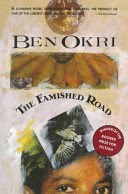
The Famished Road by Ben Okri

Ben Okri was born in Minna, Nigeria in 1959. He studied comparative literature at Essex University. The Famished Road (1991), is dedicated to Grace Okri, the author's mother, and his partner, Rosemary Clunie, a UK painter and print maker. This Man Booker Prize winner has written the classic magical realist novel of West Africa, in the tradition of Gabriel García Márquez . The title was taken from a poem by Wole Soyinka (1986 Nobel Prize for Literature) – "May you never walk / When the road waits, famished."

The story, a blend of Yoruba myth and postcolonial postmodernity, is set on the eve of independence of Nigeria in 1960. In Yoruba thought, death is not the end of life; it is rather a transition from one form of existence to another. Its narrator is Azaro, a "spirit-child,'' an abiku, a famished baby of ambiguous existence, who is destined to die in infancy and be reborn to the same mother over and over again. Okri describes Azaro's struggle to resist his fate and to survive with his family hunger, disease, and violence. The story is simultaneously situated in the world of dream, of those waiting to be born, of dead. Azaro's spirit-companions are constantly trying to pull him back into their world. Azaro's father undergoes a series of mythic battles and his mother keeps the family together with her courage and hard work. The sinister shaman Madame Koto, whose bar Azaro visits, degenerates with her corrupt deals. Finally Azaro must choose between pains of mortality and the land of spirits.

The 500-page novel is made up of 8 Books. The Famished Road is told in the 2nd person from Azaro's point of view. To get a sense of the book's scope, it is interesting to summarize the action:

SECTION ONE. Book One: "In the beginning there was a river. The river became a road and the road branched out to the whole world. And because the road was once a river it was always hungry" (p. 3). So begins the book. Lazaro speaks on behalf of the other spirit-children or abiku when he says "There was not one amongst us who looked forward to being born. We disliked the rigours of existence, the unfulfilled longings, the enshrined injustices of the world, the labyrinths of love, the ignorance of parents, the fact of dying, and the amazing indifference of the Living in the midst of the simple beauties of the universe. We feared the heartlessness of human beings, all of whom are born blind, few of whom ever learn to see." (p. 3). The spirits lure him out of his body and he finds himself in a coffin, presumed dead. on recovery his name is shortened to Azaro. An herbalist offers to sever Azaro's connection to the spirit world, but his parents could not afford the ceremony (p. 8). His colorful entanglements with the 'other side' fill much of the book. Azaro had made a promise to return, which will haunt him later. Azaro learns to ignore spirits camouflaged as normal people. Azaro makes contact with Madame Koto (p. 47), local bar owner.

Book Two: Azaro befriends Madame Koto and spends his time at the bar, but she worries that he brings bad luck. She hangs a fetish to remedy the situation. As a result, many new clients arrive (mostly spirits). Azaro is kidnapped by two albino spirits at the bar. Azaro escapes in the marsh. Politicians (Party of the Rich) come to the village and hand out free powdered milk. The milk was tainted and the sick villagers revolt. Azaro realizes the fetish is attracting spirits. He steals the fetish and buries it in the forest. Azaro wanders into the city only to discover his father working as a salt porter: "My wanderings had at last betrayed me, because for the first time in my life I had seen one of the secret sources of my father's misery" (p. 149). His father is ashamed at his discovery. Thugs from the Party of the Rich return and wreak havoc. Theme of good vs. evil begins.

Book Three: Madame Koto's bar is expanding. Azaro saw a girl in the bar that Madame Koto could not see. The spirit girl kept blowing out his match (p. 209). Thugs from the Party of the Rich promised to get Madame Koto electricity. Madame Koto starts to place greed and power over what is right. Azaro returns home to witness blood and machete marks at their home. Azaro has a vision of his mother dying. He feels his 3rd eye opening (p. 229). Azaro's father schemes to borrow money from Madame Koto to pay the rent. Azaro recognizes the poisoned milk distributor at the bar. Azaro slept and woke to find a frightening mask. He stared through it to see a different world (p. 245). He returned to the clearing where he buried the fetish. A tree had grown there, which he climbed and wore the mask to see the world change drastically. A giant approached. The mask stuck to his face. The beast attacked him, he lost the mask, and the beast crushed it.

Azaro's father tells story (p. 258) of the "King of the Road." The king would eat travelers who did not make food sacrifices to him (not unlike Amis' short story The Little Puppy That Could in Einstein's Monsters). People set out to poison him and it made the king go mad and eat himself until only his stomach was left. The stomach became part of all the roads and the king was still out there waiting and hungry.

Book Four: Koto upgrades the bar with a gramophone machine, Azaro thinks it is a spirit box. Prostitutes and many spirits start to populate the bar. Azaro wandered the woods and saw a white man giving orders to workers hooking up electricity. The white man kills a lizard (p. 278), considered bad luck. Thugs attack Azaro's father because of his politics. The rainy season arrives. A pit opens up and swallows the white man giving orders, his arrogance sealed his fate (p. 288). Ironically, the white man thought they were the real Kings. At the bar a 3-headed spirit tells Azaro to shut his eyes. He could still see (3rd eye) (p. 298). The 3rd eye is considered to be the eye to look into the spirit world and into one's self. The mystical hidden eye made Azaro a much more powerful person. The spirits pressure Azaro to return to the spirit world and keep his promises (made in Book One). Azaro refuses and is told to expect a 4-headed spirit to come for him next.

Book Five: Azaro's father has decided to train to be a boxer. Azaro gets into more trouble with the spirits and his father beats him senseless. Azaro stops eating and he "began to leave the world" (p. 325). He retreats further to punish his parents as they stand vigil next to his bed. The 3-headed spirit joined him on the 4th day. Azaro follows the spirit against his better judgement because he is mad at his parents. He came to a valley with ever-changing colors. The spirit explained the meaning of Heaven. His father's shouts materialized as a storm. His mother wept and houses flooded (p. 331). They approached a great river, a ferryman wants them to cross. Azaro's father had an herbalist at his bedside and cut a chicken and let it bleed on Azaro (p. 339). The spirit let out a scream, started losing heads, and died. Azaro wakes up to elated parents.

In this book, Azaro has the ability and knowledge that he can return to the spirit world to "live" and physically "die." he makes the active decision to bear out life's difficulties despite the other easy way out. his effort to spite his parents was reckless as his return was a close call (the herbalist had to intervene). Although his parents were at his bedside, he was worlds away. Okri beautifully captures the symbolism between the parents actions (yelling, crying) and what happens in the spirit world.

SECTION TWO. Book Six: Azaro's father became obsessed with boxing and called himself Black Tyger. His appetite grew and Azaro and his mom had to eat less. Azaro noted in the darkness, floating yellow eyes were watching his father shadow boxing. The yes went into a swamp and Yellow Jaguar emerged to challenge Azaro's father. They engaged in a massive fight, trading advantages. Azaro cried out "USE YOUR POWER" (p. 357) and eventually his father won. He said that a man named Yellow Jaguar had been a famous boxer in the area. Azaro realized that his father had beaten a boxer from the spirit world (p. 358). His father was disappointed that no one had seen the fight. As son of a powerful spirit priest, Azaro's father does not take advantage of his power until this point in the novel.

Azaro saw a shadow that turned into a boy, Ade (p. 369). They became friends. Madame Koto bought a car and would careen around the neighborhood wildly. Her bar began to serve beer, higher class than palm wine (p. 383). Azaro's father challenged 7 men to a fight at once and beat all of them. His notoriety grew. Thugs came by his house with the Green Leopard (p. 393), a former boxing champion. A blind man distracted the father during the fight. A large crowd had placed their bets on the Green Leopard. Again, Azaro's father found the will to win, despite the pummeling he took. The father went into a deep sleep, and fought a 7-headed spirit who wanted Azaro. Azaro's grandfather had attacked the spirit and cut off two of its heads. The Priest of Roads had freed Azaro's father by taking his place. He used boxing as a channel to the spirit world. Azaro's father started reading classic books like Arabian Nights and the Bible. His father wanted to do something for the downtrodden, because he now had a clear vision of right and wrong. Azaro's father threw a party (p. 413) attended by beggars (led by the beautiful Helen (p. 442)), thugs, and wizards. A melee broke out.

Book Seven: Azaro goes to Madame Koto's to spy on her for his father. He has a vision for the country and wants to discuss politics. A fight breaks out between the thugs and the beggars. Azaro has a vision that 5-headed spirit is coming. Azaro met a female midget at the bar (p. 458). He saw that many of the politicians had goat legs and hoofs for feet. The midget morphed into a 4-headed spirit. A man in a white suit hit Azaro's father. A crowd placed bets against Azaro's father. He could not seem to touch the strange looking man. The blind man again distracts Azaro's father. Ade helps to remove the blind man. Ade had a magic that would not work on someone wearing white (p. 472). Ade and Azaro are kindred spirits. Many spirits liked to "live" in the material world and pretend to be alive. Azaro's father grabs the opponents collar and rips his coat and pants. The man looked inhuman and like an animal. With the loss of his white clothes, the father was able to beat him. Azaro's father was hanging on for life back at the house. Azaro and his mother were both in the father's dream. They awoke and worked to bring back the father's spirit (p. 481).

SECTION THREE. Book Eight: Azaro's father was redreaming the world (p. 492), trying to make it right. He lived out whole lives in other lands. Azaro's father awoke on the 3rd day and said they were protected. Azaro's father's greatest battle was in his head. He fought, lived, died, was born and repeated the process of living in various different lives in the "real" time span of 2 days. The story ends upbeat with the individual able to make the world better.

In this native culture, there is a strong link between the living and the dead. Reincarnation is very real and spirit people can remember earlier lives. Spirit children are misunderstood and feared by common villagers because they communicate with the dead. The close link to the spirit world makes the notion of death more akin to a vacation. It is assumed that souls don't really die; they wander the earth waiting to be reborn in a new body. Okri says "The world is full of riddles that only the dead can answer" (p. 75).

Friday, January 21, 2011

More Die of Heartbreak by Saul Bellow


Saul Bellow is Martin Amis' favorite author, he virtually worships him, so as an Amis fan, I will be reading some of Bellow's oeuvre. Bellow was born in Quebec, two years after his parents emigrated from St. Petersburg, Russia, but spent most of his life in the Humboldt Park neighborhood of Chicago. He won the Nobel Prize in Literature in 1976, soon after Humboldt's Gift was published. Bellow wrote this book (1987) in his eighties, Amis' review of the book appears in Visiting Mrs. Nabokov. Bellow's novels tend to be light on plot - Blades (Chicago Tribune) opines "conversation, not action, is character." He calls Bellow our preeminent "op-ed novelist" whose craft bears fruit in this tragicomedy of Eros. Bellow pokes fun at himself in the novel saying "I've got a scheme for pushing Flora Lewis off the op-ed page and taking her place" (p. 102).


The book takes place in an unnamed (better to say nameless) Midwest Rustbelt (pp. 146, 246) city, although there is a hint that it could be Indianapolis (p. 251). Much of the novel is narrated by the prolix intellectual Kenneth Trachtenberg, suffering from "partial deafness" (p. 47), who has an unnaturally intense reverence for his luftemensche maternal uncle, Benn Crader, botanist (Professor "Chlorophyll" (p. 26)). Ken has emigrated to the U.S. from Paris to be closer to his uncle, but there are early signs of this backfiring: "I had come to America to complete my education, to absorb certain essential powers from Uncle, and I learned presently that he was looking to me for assistance" (p. 92).


Ken is witness to another whose life is more colorful than his. "Adoration" is an understatement of Ken's feelings toward Benn. Ken on Benn "For me he had the "magics"" (p. 23). "Ours was a genuine, I'd say a devouring, friendship" (p. 26). "My only aim was to protect his goddam life" (p. 32). "In some sense he had become my father" (p. 34). The two are both Profs at the local university, Ken a Russian studies expert. Ken and Benn seem to be unable to overcome problems they are having with relationships, especially with strong and "aggressive" (p. 86) women. They are both the walking wounded of the sexual revolution. This is in contradistinction to the notorious philandering father Rudi Trachtenberg, born in "Valparaiso" (p. 24) and living the ex-pat life in Paris as an "outstanding cocksman" (p. 65). "He put on the kind of sex display you see in nature films" (p. 24). "Papa didn't end a ruined débauché...I'm the one with the damages" (p. 35). His sexual inferiority is a "phallic cross I've had to carry" (p. 189). For their part, Ken and Benn view love in a morose fashion: "Except in a melancholy connection, you seldom hear about love anymore" (p. 44).


Ken analyzes to the nth degree ("I was going too far in my speculation" (p. 80)) the passive Benn's misfortunes with women, especially a brief encounter with one Della Bedell, a neighbor, who seduces him (against his will, well he felt it would be unfair to her to resist) after luring him into her apartment to change a light bulb. Later, Benn plans to marry Caroline Bunge, while Ken is in Seattle meeting with his ex-girlfriend Treckie to discuss parenting of their daughter Nancy. Benn makes an "undignified escape" (p. 75) from Caroline by taking Ken on a trip to Kyoto, but the overt sexuality of a strip show sends the two packing back to the Midwest.


Benn's major love interest is the beautiful and wealthy Matilda Layamon. She was well educated with "more degrees than a thermometer" (p. 136). He marries her (albeit without Ken's permission!), Ken is "still sore because he cheated on me - broke the rules of our relationship" (p. 113). They occupy a 1911 Baroque apartment (the Roanoke) which plays prominently in the relation with Matilda. In Ken's words "it's a three-cornered match: Matilda, me and the Roanoke" (p. 154). Benn is drawn into a vortex of scheming around the recovery of a real estate fortune made by Benn's own uncle (Harold Vilitzer) at the expense of Benn's family homestead, ultimately the site of a 102-floor (p.200) skyscraper owned by a Japanese multinational, "Ecliptic Circle Electronics" (p. 44). In the end, Vilitzer dies from a heated discussion prompted by a force discussion with Benn on the topic of repatriating some of the funds to Benn and his sister Hilda. Benn sends his wife ahead to the funeral in Miami and books himself a trip to the North pole for his lichen studies. Ironically, Benn's trip to the North Pole removes him from the "magnetic attraction of anarchy" (p. 330).


Ken indicts the marriage to Matilda, citing Balzac "Balzac very specifically tells you that only children born to wealth make dangerous wives" (p. 48). In general Ken disapproves of Benn's women, calling him " a phoenix who runs after arsonists" (pp. 198-199, 334). And further assessing Benn's "betrayal" - "and Uncle Benn, hitherto eligible to be described as a dear man, even a good man, assisting to the degradation of Love. Love, the very essence of the Divine Spirit" (p. 277). Early in the book, Ken refers to "the fallen state in which our species finds itself" (p. 19). Ultimately, Benn blames himself for losing his connection to his inner self, symbolized by his failure to spot a fake azalea: ' "A stooge azalea - a stand-in, a ringer, an impostor, a dummy, a shill ! I was drawing support for weeks and weeks from the manufactured product. Every time I needed a fix, a contact, a flow, I turned to it. Me, Kenneth ! After all these years of unbroken rapport, to be taken in." He cried this out - I could see it - among all those washers and dryers. "The one thing I could always count on. My occupation, my instinct, mt connection...broken off" ' (p. 300).


Lest the reader forget, Ken has his own problems with women, including Treckie and Dita. He recognizes the analogues in his own life: "All this may appear to be about me. It really isn't; it's about Uncle Benn, the circumstances of his marriage to Matilda Layamon, the struggle with Harold Vilitzer that resulted from it. I bring it forward only as it relates to him. But of course I was affected by these thoughts on the sexual problem and I took part in all of this" (pp. 73-74).


Visiting his mother Hilda in a Somali refugee camp in Tug Wajale (p. 118), Ken laments his lack of success in getting her sympathy for his formulation that "The East has the ordeal of privation, the West has the ordeal of desire" (p. 100). "I suppose I shouldn't have brought my preoccupations to this land of famine and genocide" (p. 101).


Ken is endlessly doting on life's "pain schedule" (pp. 11, 100) where "the hardest items of all have to do with love" (p. 11). Benn's amatory ineptitude is worrisome to Ken. Ken believes Benn "was a sex-abused man" (p. 54), "a woman-battered man" (p. 55). "Benn was a plant artist who was not qualified to be a love artist" (p. 301). In response to a reporter's question about the effects of radiation on plant life, Benn says "I think more people die of heartbreak than of radiation" (pp. 87, 241, 315). On love, Benn says to Ken "Your views on love are pretty familiar to me - that everybody is on a separate system" to which Ken replies "The petit système à part" (p. 192). Back on the heartbreak theme "there are no mass movements against heartbreak, and no demonstrations against it in the streets" (p. 197).


Ken also keeps recalling the "long polar night" (pp. 20, 54) theme based on Admiral Byrd's memoir Alone, where those who withstand isolation in small groups for long periods of time really "find each other out...You are hemmed in on every side by your inadequacies" (p. 20). The narrator mentions the Russian labor camps in Kolyma (pp. 20, 100) and Magadan (p. 100) - could this have encouraged Amis to write his Koba the Dread ? Also Ken mentions that in Paris he "used to visit Boris Souvarine, the great biographer of Stalin" (p. 26). Ken keeps quoting the English poet Matthew Arnold "who wrote that he was thirty years old and his heart was three parts iced over" (pp. 72, 128, 278), an image from Ken's mentor in Paris, Yermelov (p. 72).


Benn muses on his own way of seeing the world: "It was Lena who had introduced me to the valuable idea that modes of seeing were matters of destiny, that what is sent forth by the seer affects what is seen. She liked to give the example of Whistler the painter when he was taken to task by a woman who said "I never see trees like that," He told her, "No, ma'am, but don't you wish you could?" (p. 305). Whistler's interlocutor deprives herself of rich and vital pictures of the world. This vignette appears in Owen Barfield's study in anthroposophy, Saving the Appearances (p. 24), a book which influenced Bellow in the writing of Humboldt's Gift.


Bellow's narrator turns a simple fable into a complex meditation. Ken ponders the meaning of life and opines "you have no reason to exist unless you believe you can make your life a turning point" (pp. 68, 188, 247). And later: "I was referring to my Project Turning Point - that, really, conscious existence might be justified only if it was devoted to the quest for a revelation, a massive reversal, an inspired universal change, a new direction, a desperately needed human turning point" (p. 315). ""Useful elucidation" was another weakness of mine" (p. 92). Just maybe all of Ken's thoughts "don't get us anywhere: our speculations are like a stationary bicycle. And this, too, was dawning on me. These proliferating thoughts have more affinity to insomnia than to mental progress. Oscillations of the mental substance is what they are, ever-increasing jitters" (p. 301) Towards the end of the book, regarding Benn's remorse of his uncle's death, Ken learns from Benn that "you can love a man without loving what he did to you" (p.323).


Bellow pokes fun at Ken's expense when Ken stumbles on a passage from German writer E.T.A. Hoffman that parodies Ken's concern for Benn's survival among the American philistines: " 'Oh, Ferdinand, dearest, beloved friend!...what will become of the arts in these rough, stormy times ? Will they not wither like delicate plants that in vain turn their tender heads towards the dark clouds behind which the sun disappeared ?...The children of Nature wallowed in lazy idleness, and the most beautiful gifts she offered them they trampled under foot in stupid wantonness...' " (p. 331).


Bellow defines his own fictional style "if you want to think in America, you also feel an obligation to provide a historical sketch to go with it, to authenticate or legitimize your thoughts. So it's one moment of flashing insight and then a quarter of an hour of pedantry and tiresome elaboration - academic gabble. Locke to Freud with stops at local stations like Bentham and Kierkegaard. One has to feel sorry for people in such an explanatory bind. Or else (a better alternative) one can develop an eye for the comical side of this" (pp. 190-191). Pifer (Saul Bellow: Against the Grain) opines that in this novel, Bellow may have reached a "turning point" not only in his own career but in the development of the realist novel: a point at which the "primordial person" rather than his alteration by "the conditioning forces," is of crucial interest. In Bellow's own fiction, in any case, it is the "secret" of the human being, his "hidden design," that the novelist's art is increasingly dedicated to unfolding.

The War Against Cliché by Martin Amis

The War Against Cliché (2001) is probably the best choice one could make for the final reading assignment, if intending to read all of Amis' oeuvre, as it spans a huge canon of literature and other media. So here I am - 20 books later on a project that started last June.

Saturday, January 15, 2011

The Moronic Inferno: And Other Visits to America


As the title indicates, this book is highly critical of America, but it is a criticism tempered and somewhat confounded by Amis' complicated Ameriphilia. After all, he has made a habit of sending his characters to America (John Self in Money, the narrator in London Fields, and Richard Tull in The Information; he imports Americans in Dead Babies as well as Rachel's boyfriend in The Rachel Papers). The preoccupation with nuclear destruction carries over from Einstein's Monsters. Diedrick opines that this effort to force a collection of disparate essays to fit a conceptual scheme imposed retrospectively is strained. Such pigeonholing is unnecessary and irrelevant. He warns that these are journalistic articles, "the hack and the whore have much in common: late nights, venal gregariousness, social drinking, a desire to please, simulated liveliness, dissimulated exhaustion- you keep having to do it when you don't feel like it" (p. x). In the introduction to The Moronic Inferno (1986), Amis explains the title's origin:

"I got the phrase 'the moronic inferno', and much else, from Saul
Bellow, who informs me that he got it from Wyndham Lewis.
Needless to say, the moronic inferno is not a peculiarly American
condition. It is global and perhaps internal. It is also, of course,
primarily a metaphor, a metaphor for human infamy: mass, gross,
ever-distracting human infamy. One of the many things I do not
understand about Americans is this: what it is like to be a citizen of a
superpower, to maintain democratically the means of planetary
extinction?" (p. x).

Consider some of his reviews of contemporary authors. In general "British critics tend to regard the Amercan predilection for Big Novels as a vulgar neurosis - like the American predilection for big cars or big hamburgers" (p. 1). Nevertheless, regarding William Burroughs he says "Like many novelists whose modernity we indulge, William Burroughs is essentially a writer of 'good bits' - ironically, Amis has been criticised for insufficient plot. Regarding John Updike's Rabbit trilogy, "Updike toys with plot and incident, then flirtatiously retreats" (p. 156) and "In every sense it constitutes an embarrassment of riches - alert, funny and sensuous, yet also garrulous, mawkish and cranky. Updike often seems wantonly, uncontrollably fertile, like a polygamous Mormon" (p.157). Amis could be easily describing himself (maybe he is). His comments on Philip Roth reveal his own tendencies as well. Amis identifies 3 kinds of Roth women, the "Girl Who Will Do Anything", the "Ball-Breaker", and the "Big Woman" (pp. 42-43). These 3 women are found in London Fields, in Nicola, Hope, and Kath, respectively. The two essays on Saul Bellow form the bookends of this collection. Bellow says "Death is the dark backing a mirror needs if we are to see anything" (p. 202), a phrase applicable to the protagonists in Other People and Money. This line also appears in The Pregnant Widow (p. 364).
Truman Capote represents all that is American excess: "Truman Capote lived the life of an American novelist in condensed and accelerated form. By the age of eight he was a writer, by the age of twelve he was a drunk, by the age of sixteen he was a celebrity, by the age of forty he was a multimillionaire, and by the age of fifty-nine he was dead" (p. 40).

Steven Spielberg's secret connection with his audience is ascribed in part to "the very blandness of his suburban origins - a peripatetic but untroubled childhood...I wondered if he had ever really left the chain-line ranch-style embryos of his youth" (pp. 147-148).

Amis' essay on AIDS ("Double Jeopardy: Making Sense of AIDS") is noteworthy for what Diedrick (Understanding Martin Amis) calls "an example of sustained imaginative sympathy." Amis begins by inviting the reader to step into the shoes of a gay male. The assault is two-fold, for being gay and a public health menace. He uses the colloquial term "5-H club" (hemophiliacs, Haitians, homosexuals, hookers, and heroin addicts). My post (2/21/10) on Amy Wilentz' book The Rainy Season mentions the Creole word katrach, referring to the four "H"s (homosexuals, hemophiliacs, heroin users, and Haitians), a derogatory expression that now irks Haitians.