Saturday, March 4, 2017

Cate Blanchett's guy updates Chekhov's 1st play (1878)


Cate Blanchett's husband, Andrew Upton, adopted Chekhov's first play, Platonov (1878) under the title The Present. "London Calling" and "Death or Glory" by the Clash and "What is Love" by Haddaway place this milieu mid-80s. All actors in this production were Australian under the Sydney Theatre Co. and performed at the Barrymore Theater.  Blanchett made her Broadway debut in this play directed by John Crowley.  

Platonov, the name in English given to an early, untitled play in four acts written by Anton Chekhov in 1878. It was the first large-scale drama by Chekhov, written specifically for Maria Yermolova, rising star of Maly Theatr Yermolova rejected the play and it was not published until 1923.  The lead character is Mikhail Platonov, a disillusioned provincial schoolmaster. The play is set in a dilapidated country house in the Russian provinces. Landowner Anna Petrovna, Sofia Yegorovna, wife of Anna Petrovna's stepson, and one of his colleagues fall in love with the married Platonov. He thinks society is without ideas and principles, but is aware that he himself is very much part of that society. He is compared to Hamlet and Don Juan, and likes to think of himself as a witty and intellectually stimulating entertainer. In the end, he recognizes his hopeless position between the four women and retreats into alcohol. Finally, Sofia understands that she cannot hope for a new life with Platonov and shoots him.

It may seem an unexpected choice for a Chekhov play from pre-revolutionary Russia, but for The Present, which is set in the post-perestroika world of the Russian oligarchs, Upton and Crowley have threaded the production with evocative music from the world of punk rock. “Andrew’s first draft referred to a couple of lyrics from a Garage track and a Joy Division track, so we looked at what the musical scene would have been when the characters were young, when Platonov would have been going to university,” Crowley explains. The playwright and director then settled on the music of The Clash, the English punk-rock band of the mid 1970s, to underscore the production.

Wednesday, March 1, 2017

NERVE / The New Nude (2000) by Genevieve Field, Ed.


Robert Mapplethorpe (1946-1989, HIV/AIDS) blew out all the boundaries of the "Last Taboo" (see Wesley Morris in The New York Times Mag, 10.13.16, p. 48) when he exhibited a veritable phallic phalanx of black penises, all playing into the "national terror of black sexuality."  In 1990, the Cincinnati Contemporary Arts Center ("CAC") was charged with obscenity based on the homoerotcism displayed in Mapplethorpe's retrospective The Perfect Moment.  Years later, CAC restaged the exhibit under the title After the Moment in 2015 marking the 25th anniversary, bringing in a variety of artists who now navigate a changing artistic landscape since Mapplethorpe.

If anyone has taken the baton since 1989, it is Nan Goldin, whose book The Ballad of Sexual Dependency, was the culmination of living with and recording friends in bohemian New York.  Goldin's work is featured in the Nerve book. Other contributors include Leslie Lyons (who contributed the dramatic book cover), Sylvia Plachy, Greg Friedler, Robert Maxwell and Charles Gatewood.  Genevieve Field notes that the body is a "palimpsest upon which biographies are written and erased over the course of a lifetime....it is the source of life and a document of erosion; and it is both loved and despisd for its elemental sexuality."  Photographers seek trust in the relationship between artist and model even more so than painters and sculptors.  The artist needs the subject's expressive offerings.  Nerve's "new nude" explores the subject's humanity and sexual character as well as the photographer's vision.

The old masters of photography avoided the sexuality of their subjects by applyig the rules od still-life photography.  They understood light and didn't want their models to upstage it.  The photographers painted a mood but it rarely emanated from the model.  New photographers read the body by coaxing it out of its standard vocabulary of gestures and poses to express an unscripted state of mind.  The empathy between photographer and subject allows an exploitative dynamic rather than being merely voyeuristic.  Field notes "It is what allows a sexually charged image to transcend the pretentiousness of erotica and the egotism of pornography."

Well the "new nudes" can't be tweeted but they can be "selfies."  Unabashedly pointing their lenses "at the grity corners of their own sexual lives, these photographers are upturning and upstaging the visual cliche of the passive, fawn-eyed muse."
 

Wednesday, January 25, 2017

The House Book (2001) by the Editors of Phaidon Press


This heavy book is comprised of 500 color photos arranged alphabetically by architect, patron, or designer. Notable entries include:

Udaipur Garden Palace (1698-1710) by Amar Singh II, Udaipur, India (Reisner family visit 2001);

Anchorites in Cappadocia in central Turkey, phallic forms of residual volcanic tufa in obelisks up to 16 storeys high, locals cal them fairy chimneys;


.


Wednesday, January 11, 2017

Iconic America by Hilfiger and Lois


This intriguing book can be browsed over 335 pages in an hour.  Best icons include (p. 69) dollar bill All-Seeing Eye from the Great Seal of U.S.  Why is pyramid unfinished?  Annuit Coeptis means "He Has Favored Our Undertakings."  The Roman Numerals MDCCLXXVI are date of Declaration of Independence (1776) and Latin Phrase Novus Ordo Seclorum is "A New Order of Ages is Born."

The most arresting icon is 19-year old bare-breasted Josephine Baker (p. 289), famous black chanteuse in 1920s who performed in Paris.  Did you know that Starbucks (p. 164) was named after Starbuck, the coffee-loving first mate in Moby Dick ?

So what's missing?  1963-1967 Corvette Sting Ray !  WTF !!


Sunday, August 28, 2016

Szarkowski Tells Story Behind 100 Pictures from MoMA Collection


John Szarkowsi's book, Looking at Photographs, is the earliest (1973, 1999 revision) of three fabulous studies, including Susan Sontag's scary-brilliant On Photography (1973-1977) and Geoff Dyer's The Ongoing Moment (2005).

Thaddeus John Szarkowski (December 18, 1925 – July 7, 2007) was a photographer, curator, historian, and critic.  From 1962 to 1991 Szarkowski was the Director of Photography at New York's Museum of Modern Art.
A decision was made in compiling this book that no more than one contribution per photographer would be accepted.  So Steichen, Stieglitz and Weston, 3 pics, that's it !  The book cover photo is especially interesting as it is a photo by Alfred Stieglitz of his niece Georgia Engelhard (daughter of Agnes Stieglitz and George Engelhard). 

Some random thoughts:

The early daguerreotypes were virtually 100% portraits as opposed to landscape.  So there exists a large collection of anonymous people captured by this art form.  The photos reveal an unworldliness when compared to modern images.  Hill's photo of W.B. Johnstone, a Scottish cleric, is eerie at best as his facial features just look different.

Most people know Mathew Brady and his photos of the Civil War.  Most of the photos were actually made by staffers.   One who let was the Scottish-American Alexander Gardner, who protested he never received photo credit or profits.  His work is in Gardner's Photographic Sketchbook of the War.

Peter Emerson got caught up in the issue of artistic merit between photographers and painters.  He insisted on the issue of artistic status for photographers, while his followers were deferential to painters.  After 5 years, he recanted in a pamphlet stating that photography was only a very minor art.  Ultimately, he became the Luther of the schism.

In 1872, the former governor of California, Leland Stanford, a businessman and race-horse owner, hired Eadweard Muybridge for some photographic studies. He had taken a position on a popularly debated question of the day — whether all four feet of a horse were off the ground at the same time while trotting. In 1872, Muybridge began experimenting with an array of 12 cameras photographing a galloping horse in a sequence of shots. His initial efforts seemed to prove that Stanford was right, but he didn’t have the process perfected. The same question had arisen about the actions of horses during a gallop. The human eye could not break down the action at the quick gaits of the trot and gallop. Up until this time, most artists painted horses at a trot with one foot always on the ground; and at a full gallop with the front legs extended forward and the hind legs extended to the rear, and all feet off the ground.  Stanford sided with the assertion of "unsupported transit" in the trot and gallop, and decided to have it proven scientifically. Stanford sought out Muybridge and hired him to settle the question.


Galloping horse, animated in 2006, using photos by Eadweard Muybridge
Between 1878 and 1884, Muybridge perfected his method of horses in motion, proving that they do have all four hooves off the ground during their running stride. In 1872, Muybridge settled Stanford's question with a single photographic negative showing his Standardbred trotting horse Occident airborne at the trot. This negative was lost, but the image survives through woodcuts made at the time (the technology for printed reproductions of photographs was still being developed). He later did additional studies, as well as improving his camera for quicker shutter speed and faster film emulsions. By 1878, spurred on by Stanford to expand the experiments, Muybridge had successfully photographed a horse at a trot;  lantern slides have survived of this later work.  Scientific American was among the publications at the time that carried reports of Muybridge's ground-breaking images.
Stanford also wanted a study of the horse at a gallop. Muybridge planned to take a series of photographs on 15 June 1878, at Stanford's Palo Alto Stock Farm (now the campus of Stanford University). He placed numerous large glass-plate cameras in a line along the edge of the track; the shutter of each was triggered by a thread as the horse passed (in later studies he used a clockwork device to set off the shutters and capture the images). The path was lined with cloth sheets to reflect as much light as possible. He copied the images in the form of silhouettes onto a disc to be viewed in a machine he had invented, which he called a "zoopraxiscope". This device was later regarded as an early movie projector, and the process as an intermediate stage toward motion pictures or cinematography.
The study is called Sallie Gardner at a Gallop or The Horse in Motion; it shows images of the horse with all feet off the ground. This did not take place when the horse's legs were extended to the front and back, as imagined by contemporary illustrators, but when its legs were collected beneath its body as it switched from "pulling" with the front legs to "pushing" with the back legs.

Alvin Coburn was focused on photography as a creative art.  Szarkowski opines the fundamental stumbling block seemed to be the medium's uncompromising specificity.  The camera described not Man but men, not Nature but countless biological andgeological facts.  The artistic spirit of the time preferred an idealistic view.  Coburn's friend Ezra Pound, writing about Coburn's abstractions, invoked Walter Pater's dictum that "all arts approach the condition of music" (i.e. the arts seek to unify subject-matter and form, and music is the only art in which subject and form are seemingly one), which appeared in his 1873 book The Renaissance: Studies in Art and Poetry.

E.J. Bellocq was a commercial photographer in New Orleans.  After his death 100s of photos were found of prostitutes.  His portraits are highly individualized and the women have realized themselves in pictures.  Lee Friedlander bought them and printed the plates.

Aerial reconnaissance  photographs are featured in the collection.  Daumier said that photography depicted everything but explained nothing.  Traditional painting explained everything but described nothing.

Brassaï (Gyula Halász) pronounces his name "bra sigh ee."  Same as French spelling of Haiti: République d'Haïti; Haitian Creole: Repiblik Ayiti,   He took his name from the town of his birth, Brasso, in Transylvania, then part of Hungary, later of Romania, and famous as the home of Count Dracula.  Published his famous book Paris de Nuit in 1933.  Brassaï gained notoriety as 'the photographer' in Tropic of Cancer (1934) by his friend Henry Miller. 

Paul Caponigro is best known for his landscape works and for the mystical and spiritual qualities of his work. He is often regarded as one of America's foremost landscape photographers.

Ardara Dolmen, County Donegal, Ireland, 1967

Robert Doisneau, At the Cafe.  Szarkowski reads so much into this photo.  "The girl's secret opinion of the proceedings so far is hidden in her splendid self-containment; for the moment she enjoys the security of absolute power.  One arm shields her body, her hand touches her glass as tentatively as if it were the first apple.  The man for the moment is defenseless and vulnerable; impaled on the hook of his own desire, he has committed all his resources, and no satisfactory line of retreat remains...This pair, if less romantically conceived than the lovers on John Keats' urn, are equally safe, here in the picture, from the consequences of real life."


Saturday, August 27, 2016

Geoff Dyer's Irreverent Insights on Photography Astound


Susan Sontag opens her seminal essay with the Plato's Cave allegory, Dyer follows with an equivalent compelling literary metaphor referring to Borges' 'certain Chinese encyclopedia.'  It is the Celestial Emporium of Benevolent Knowledge, said to divide animals into "(a) those that belong to the Emperor, (b) embalmed ones, (c) those that are trained, (d) suckling pigs, (e) mermaids, (f) fabulous ones, (g) stray dogs, (h) those that are included in the present classification, (i) those that tremble as if they are mad, (j) innumerable ones, (k) those drawn with a very fine camelhair brush, (l) others, (m) those that have just broken a flower vase, (n) those that look like flies from a long way off."  Dyer is using Borges' fictional taxonomy as an eccentric template for organizing his book.  Dyer's approach is aleatory, released from the tyranny of chronology.  Dyer has written The Ongoing Moment as a single, 254-page chapter, as if to emphasize that the sense that all photographs are one; or at least linked in a huge electronic tapestry.

Ultimately the categories look like:

blindness (inc Arbus - Borges and Avedon - Borges)
Diane Arbus
hands
photographing thought/fasion models
 photographs of photographers
nudes/girlfriends
suicide in people's faces
Weston / Charis
people's backs
hats
airial views
empty beds
benches
fences
architecture
windows
streets/desert roads
gas stations
barber shops
open doors
corpses
poverty

The question underlying The Ongoing Moment is "What can one do with the time facing a photograph, or facing anything else for that matter?" (Stephen Mitchelmore).  Dyer expresses the question writing about Alfred Stieglitz’s photograph of Fifth Avenue around 1901: “To think, there was a time, over a century ago, when this moment was now!”. He imagines the caped figure walking towards the camera looking back to see himself no longer there. But this is impossible: “it is his peculiar destiny … never to arrive at that backward looking vantage point, but to be rendered, momentarily and perpetually, as patient as the waiting horse and the buildings which are still there too.”

Borges' "The Analytical Language of John Wilkins"

"The Analytical Language of John Wilkins" is a short essay by Argentine writer Jorge Luis Borges and is a critique of the English Philosopher Wilkins' proposal for a universal language and of the representational capacity of language in general.  Borges also examines a bizarre and whimsical Chinese taxonomy quoted by Foucault and also Geoff Dyer in his 2005 photography study The Ongoing Moment.

Borges begins by noting John Wilkins' absence from the 14th edition of the Encyclopædia Britannica and makes the case for Wilkins' significance, highlighting in particular the universal language scheme detailed in his An Essay towards a Real Character and a Philosophical Language (1668). Wilkins' system decomposes the entire universe of "things and notions" into successively smaller divisions and subdivisions, assigning at each step of this decomposition a syllable, consonant, or vowel. Wilkins intended for these conceptual building blocks to be recombined to represent anything on earth or in heaven. The basic example Borges gives is "de, which means an element; deb, the first of the elements, fire; deba, a part of the element of fire, a flame."

Examining this and other second-hand examples from Wilkins's scheme—​​he did not have access to Wilkins' actual work, but based his comments on the others' comments on it—​​Borges believes he finds "ambiguities, redundancies and deficiencies", concluding "it is clear that there is no classification of the Universe not being arbitrary and full of conjectures." He fancifully likens Wilkins's classification scheme to a "certain Chinese encyclopedia," likely fictitious, called the Celestial Emporium of Benevolent Knowledge, said to divide animals into "(a) those that belong to the Emperor, (b) embalmed ones, (c) those that are trained, (d) suckling pigs, (e) mermaids, (f) fabulous ones, (g) stray dogs, (h) those that are included in the present classification, (i) those that tremble as if they are mad, (j) innumerable ones, (k) those drawn with a very fine camelhair brush, (l) others, (m) those that have just broken a flower vase, (n) those that look like flies from a long way off." Borges' point is the arbitrary nature of such taxonomies, regardless of whether they form a language or just a way of understanding and ordering the world. He challenges the idea of the universe as something we can understand at all—​​"we do not know what thing the universe is"—​​much less describe using language.

Sunday, March 6, 2016

Redeeming Calcutta by Steve Raymer


Steve Raymer, professor at Indiana Univ. at Bloomington, knows his subject as evidenced in his Introduction. The color photos are excellent and buck the recent trend to go black and white when photographing Calcutta.  Most interesting is reference to trashing articles, e.g., Ved Mehta in the New Yorker (1970) and two books by Gunter Grass, Show Your Tongue and The Flounder. Oxford Univ. Pressis the publisher, wehich has been in India over 100 years.

Here are a few gems from the Intro.

Calcutta is a place where British dreams of global domination were given their most extravagant expression.  Calcutta's redbrick High Court, is a replica of the statehouse in Ypres, Belgium, though with a shortened tower since its marshy foundations could not bear the weight of a perfect copy. 
The City's decline began in 1869 with the opening of the Suez Canal.  William Makepeace Thackery, Anglo-Indian poet and author of Vanity Fair, was born on the site of the Armenian College. 

Saturday, December 26, 2015

¡Vámonos! Bernard Plossu in México 1965-66, 1970, 1974, 1981

 Bernard Plossu is a well-known bohemian French itinerant photographer.  He is widely published in France.  This book is a work of art in itself and catalogs 4 trips to Mexico in 1965-1966, 1970, 1974 and 1981.  His portrairs are haunting.  He loved the beatniks and had friends like Henry Miller, Joan Baez, Jack Kerouac, and even Sergio Leone, who wrote a preface to one of his books.

Bernard Plossu (born in Dalat, South Vietnam, 1945) has traveled extensively through a life in photography, including in the jungles of Chiapas in Mexico, the American West, India, the Aeolian Islands, and Niger. Widely regarded as a leading figure in French photography, Plossu’s photographs have been exhibited internationally, including at the Museum of Contemporary Art Chicago; Musée National d’Art Moderne, Paris; Centre Pompidou, Paris; Instituto Valenciano de Arte Moderno, Valencia, Spain; and Strasbourg Museum of Modern and Contemporary Art, France. He has published numerous books, including Le Voyage Mexicain: L’integral, 1956–1966 (1979), African Desert (1987), Forget Me Not (2002), Bernard Plossu’s New Mexico (2006), and Europa (2011).

Mari Olguin


"In order to understand, you have to listen to what you see," Bernard Plossu.

Sunday, December 20, 2015

The Elementary Particles by Michel Houellebecq


Quiz - who is the most famous French author since Camus ?  Michel Houellebecq, of course.  If you like your intellectuals feisty, you're in luck, as I'd guess references to fellatio occur every other page or so.  This is the story of two half brothers, Michel and Bruno, who are polar opposites.

Saturday, January 31, 2015

Saturday, April 12, 2014

Boulevard of Dreams by Constance Rosenblum

 
Before the Bronx was a Borough (1895) or a County (1915) it was part of Westchester County, one of 12 counties in NY State set up by the British.  Manhattan, hungry for new land began annexing lands surrounding in the 1890s, including ample Park space in modern day Pelham Bay Park, Bronx Park,  and Van Cortlandt Park.  Unfortunately, there was no simple access to those parks, until a "speedway" (for horses) was proposed in 1892 along a north-south ridge from the Harlem River to the Mosholu Pkwy.  The inspiration for a Bronx-style Champs Elysses was a French immigrant engineer Louis Risse.  Legislators approved the road in 1895, and took title to properties by 1898.  It was not completed until 1909.  It was the first urban thoroughfare to incorporate underpaasses.

Saturday, January 11, 2014

Gold Boy, Emerald Girl by Yiyun Li

 
Yiyun Li began writing short stories in America in her adopted English language, not unlike Ha Jin.  She is a favorite author of Amy Tan and is considered a feminist writer.  She became a MacArthur Foundation fellow in 2010 and teaches at UC Davis.
 
Gold Boy, Emerald Girl (2010) followed her novel The Vagrants.  In "Kindness", an unmarried woman, Moyan, recollects her closest relationships, a friendship with a Professor Shan, who loves English novels, Lieutenant Wei, a female army officer, and a brief crush on a man who moved out of her neighborhood. The English teacher reveals to Moyan that she is adopted (pp. 13, 73) and her mother was a nymphomaniac (p. 21).  In the Army, a friend asks her to translate the sexy passages in Lady Chatterly's Lover.  "I blushed at the words she used - zuo-ai, doing love, an innocent yet unfortunate mistranslation of the English phrase making love" (p. 31).  Inevitably, her lieutenant catches her with the book under the bedsheets (p. 39).  It is the death of Wei (p. 4) that motivates the narrator to tell her story.  At one point, Moyan develops a brief crush on a neighbor.  Shan comments "The moment you let someone into your heart you make yourself a fool...when you desire nothing, nothing will defeat you" (p. 39).   A sad commentary at best.
 
Li says she wrote this story as an homage to William Trevor:
I opened the novella with three sentences that echoed the opening sentences of Nights at the Alexandra, and while writing it, I imagined my narrator speaking to the narrator in Trevor’s novella – both characters lead a stoically solitary life, yet both are capable, and are proofs, of love, and affection and loyalty. Their conversation would not have happened in reality, but I hope that by speaking to one person in her mind, my narrator, in the end, speaks to many.
"A Man Like Him" concerns a celibate Teacher Fei (who "never cupped his hands around a woman's breasts," p. 91) who offers to assist a man wrongfully accused of adultery by his daughter, who exploits the Internet to seek revenge.  Fei's father had committed suicide (p. 89) and Fei gave his mother every chance to do the same (p. 90).  Fei's teaching career was ruined by a few moments of gazing (p. 98) at a female student, an indiscretion that branded him a pedophile (p. 99).  The Chinese character with the sound Fei means to give up or abandon - both these men have lost their livelihoods due to alleged wrongdoing for which they have no control.

In “Prison,” a Chinese couple (Yilan and Luo) living in America lose their 16-year-old daughter in a traffic accident (unintended suicide) and find their world shattered. They go to China and find a surrogate mother so that they might have another child.  The wife chooses an uneducated young woman (Fusang) whose only child has been stolen by a kidnapper several years before, and stays with her during the pregnancy with twins, fretting over imagined dangers to the unborn children. When the two women are approached by a young beggar boy on the street, the pregnant woman insists that the boy is her missing child (p. 125). When the two women get home, the girl demands that the woman give her half the money promised so that she can buy the boy back from the beggar man. When the woman asks the girl to sit down so they can talk about it, she threatens to run away and sell the twins. The story ends with a standoff as the woman thinks, “This was the price they paid for being mothers…that the love of one’s own child made everyone else in the world a potential enemy.” She knows that the relationship of trust she and the girl has developed during the pregnancy is crushed and that they will remain each other’s prisoners (p. 130).

In "The Proprietress," Mrs. Jin is the owner of a small general store in Clear Water Town. Even though she sells goods to the poor people of the village, her most important activities have little to do with her store. Her home is next to a county jail and is a safe haven for "adopted" women of all ages. Among whom is Susu, a woman who recently caused an uproar when she asked the courts to allow her to have a child with her husband before he was executed. Her request makes Susu nationally known, so much so that a reporter from Shanghai comes to Mrs. Jin’s shop to ask her a few questions.

Sunday, August 4, 2013

Taipei by Tao Lin

Tao Lin has earned the reputation as the Bad Boy of Indie novels or Alt Lit (wedded to culture of the Internet and self-publication), but can he sustain that claim now that main line publisher Vintage has published his latest autobiographical crossover novel Taipei (2013) ? The book cover is notable as an animated GIF transferred to holographic foil.  It is a love story about  Paul, a Brooklyn novelist anticipating embarking on a book tour "September 7 to November 4" (p. 93).    We know it was "twenty months ago" (p. 90) when Paul first learned of budding love interest Erin, in "January 2009") (p. 90), placing the action (or lack thereof) in August, 2011.  The vocabulary is minimalist: Stephen Marche of Esquire calls it the "Asperger's style" of literature based on disaffection and disconnection.
This novel was trashed by Lydia Kiesling in her review "Modern Life is Rubbish: Tao Lin's Taipei" in the online literary magazine The Millions, founded by Max Magee in 2003.  Her review resonated on the Internet.  She wonders "why someone who hates words would take the trouble to arrange so many of them in a row...Why does he hate me ?...Why does he inflict upon me his framework-y (p. 8) somethingness, his soil-y (p. 11) area, or the salad-y (p. 21) remains of the burrito?"  The author seems to be embarrassed by words and what they can represent and mean.  His are colorless, witless, humorless.  "Picking out individual passages cannot express the cumulative monotonous assault on the senses." 
 
LK notes that everyone's ages are "recorded, as if in a hipster police blotter, a method to describe people without really describing them."  LK sees the drug use as a good excuse for its awfulness, because it now had a Problem.  She also points out regarding sex in the book that "when the panties come off, the camera, narratively speaking, looks politely away."  Sex is awkwardly clinical, witness "At Paul's apartment they drank green juice and showered, then performed oral sex on each other, showered again, turned off the light to sleep" (p. 216).
 
Kiesling feels that Tao Lin anticipates the backlash in Taipei.  “He read an account of his Toronto reading, when he’d been sober, describing him as ‘monosyllabic,’ ‘awkward,’ ‘stilted and unfriendly’ within a disapproval of his oeuvre, itself vaguely within a disapproval of contemporary culture and, by way of a link to someone else’s essay, the internet” (p. 129).  Wow, TL writes his own book review !  Yet in a June 9 comment to Kiesling's review, a reader compares Lin the superrealist attempting to do with writing what photographers do on film: capture what is.  TL bears out this notion on the last page: Paul "briefly discerned her movement as incremental - not continuous, but in frames per second - and, like with insects or large predators, unpredictable and dangerous" (p. 248).
 
Clancy Martin (NYT, 6.30.13) takes the high road as few reviewers have done.  He elevates it to a bildungsroman, a coming of age story, like Bellow's The Adventures of Augie March.  The magic moment between Paul and Erin happens in Taipei, while visiting his parents.  CM points out that "Rather than talking about, they are talking to."  Paul finds himself focusing on their "conversation, which was producing its own, unmediated emotions" (p. 182).  Earlier the couple imagine an "unlikely romance and mutually learning the true meaning of life" (p. 140).  CM opines "life is changing from the aesthetic to the ethical...his characters have become authentic."  This is a subtle reference to Søren Kierkegaard's book Either/Or, in which the aesthetic and ethical represent sequential evolutionary stages in a young man's development.  Ironically, the word ethical refers also to drugs available only from a physician's prescription.
 
In support of CM's thesis, Paul's relationships are first classified as "obsessions", with Laura (p. 56) and Erin (pp. 109, 147).  TL tends to pathologize human emotions into illnesses.
 
The novel lacks any form of action and seems to be a form of Paul's diary, especially since no moral stance is taken toward the author's actions.  A discussion regarding a documentary on rap artist Lil Wayne's drug use is insightful to the structure of the novel.  "Paul felt it was bleak and depressing that the filmmakers superimposed their views onto Lil Wayne" (p. 98).  And so, in this autobiography, Paul never opines on the good or evil of endless pill popping, he never pathologizes on drug use.  It can be argued that the characters manipulate themselves chemically to avoid acting "crazy."  Paul says "They'll think we're on drugs if we're not on drugs.  We're normal when we're on drugs" (p. 149).
 
Many reviewers have derided the utterly simplistic vocabulary in the book, totally devoid of creative metaphor.  Yet, on occasion, compelling literary snippets surface like "Paul....stood naked in Calvin's room struggling to insert his left leg into his boxer short's left hole, which kept collapsing shut and distortedly reappearing as part of a slowly rippling infinity symbol" (p. 99).
 
Much of the language is indicative of a generation weaned on the Internet.  "Paul didn't know what to do, so he went "afk," he felt, and remained there - away from the keyboard of the screen of his face - as Erin, looking at the inanimate object of his head..." (p. 107).  The author is obsessed with how the Internet is colonizing our consciousness.  A social interaction makes him feel "a sensation not unlike clicking 'send' for a finished draft of a long e-mail" (p. 122).  The online world is more addictive than anything in a pharmacy.
 
Popular culture abounds.  Cornmeal Funyuns have been around since 1969 and are referenced in a song by Eminem.  Klonimin, Xanax, Adderall and a myriad of other prescription drugs are ubiquitous in this book.  Tao Lin refers to his literary heros Brett Easton Ellis (p. 90), Ann Beattie (p. 179, Chilly Scenes of Winter) and David Foster Wallace (p. 120).  On his way to Taipei, he contemplates getting caught and writing a meganovel Infinite Witz (p. 159), a tip of the hat to DFW's Infinite Jest and Joshua Cohen's Witz.
 

Klonopin


Funyuns
Bobst library, NYU

Sunday, April 7, 2013

The Rape of Nanking by Iris Chang


No one can ever be the same after they read this book.  Iris Chang wrote this best-selling account of the Nanking massacre in 1997, after doing exhaustive research in Nanjing and the U.S, missionary archives.  The systematic rape of several hundred thousand civilian women by the Japanese occupiers in December 1937 in addition to the torture and other countless atrocities of men and women defies one's belief system.  Sadly, the author ended her own life with a pistol to her head in a car in Los Gatos, CA, in 2004, some saying she could no longer cope with such intimate knowledge of what was perpetrated in China's capital.  This book is of special interest to me as I have a great-uncle, John Henry Reisner (1887-1965), who was a Presbyterian missionary in Nanking and Dean of the College of Agriculture and Forestry of Nanking Univ. from 1914-1931.  He left China 6 years before the Japanese invasion.  His family legacy was ever present in my childhood home, filled with Chinese lamps and rugs as he couldn't bring cash out of China.

John H. Reisner with daughter


reverse inscription, April, 1919


The daughter of two university professors. Iris Chang grew up in Champagne-Urbana, IL, graduating from Univ. Illinois at C-U in 1989.  She became a New York Times stringer and wrote her first book, Thread of the Silkworm (1995), about NASA JPL-founder Tsien Hsue-shen, who was accused of being a spy, left for China, and developed missile systems in China. 

Iris took on a much more incendiary topic when she approached The Rape of Nanking.  Unlike Germany, who made reparations of over $60 billion to individuals, restitution for lost property, and agreements with Israel and other nations (p. 222), Japan never made even a formal apology.  Oddly enough, even present day Chinese leaders are reticent about the topic in fear of upsetting their Japanese trading partner.  Her book was influenced (p. 14) by the classic Kurosawa film Rashomon (1950) (p. 19) about a rape and murder case in 10th century Kyoto.  A bandit waylays a traveling samurai and his wife: rapes the wife and kills the samurai.  Simple enough, yet the story becomes complex when the other characters relate the story, including the wife, the bandit, and a witness.  Of course, the Rape of Nanking is analogous, when told by the Chinese, Japanese, and the West.


A major question remains as to why the Japanese promulgated such aggressive westward expansion.  Chang notes that by the 1920s Japan had 60 million mouths to feed (p. 26) in a limited area of 142,270 square miles.  Moreover, the U.S. had adopted manifest destiny as the excuse for westward expansion to the Pacific Ocean, the Japanese would do the same in the socially fragmented and loosely governed China (p. 27).  Some experts blame the non-Christian nature of Japanese religion, claiming that while Christianity puts forth the idea that all humans are brothers (all things created in God's image), Shintoism purports that only the emperor and his descendants were created in God's image (p. 54).

During the Occupation, a Safety Zone was established run by Westerners.  Many Chinese hid here for long periods.  Heroes included the improbable John Rabe (p. 109), leader of the Nanking Nazi Party, Minnie Vautrin (p. 129), dean of studies at Ginling Women's Arts & Science College, and American surgeon Robert Wilson (p. 122).

Chang details the atrocities as well she should.  Use Google Image to see babies skewered on bayonets like shish kebab, raped women dead on the ground with lances plunged into their vaginas, etc.  The Japanese even had a Nazi-like experimental medical lab à la Josef Mengele, Unit Ei 1644 (p. 164), where guinea pigs they termed zaimoku were subjected to vivisection and were injected with poisons, germs, lethal gases and snake venom, including cobra, habu, and amagasa.

Despite overwhelming evidence, claims are still made that the atrocities never occurred.  Fortunately, the crimes of Nanking were filmed by John Magee (p. 156) of victims at the Univ. of Nanking Hospital.  George Fitch smuggled the 16 mm negative out of China at great risk, on a Japanese military train to Shanghai, sewn into linings of his camel's hair coat. 

The Nanjing Municipal Government built the Nanjing Massacre Memorial Hall in 1985.  This is not unique for Asia, compare with the Tuol Sleng Genocide Museum in Phnom Penh, Cambodia, where the atrocities committed by the Khmer Rouge (1975-1979) are documented.


City of Life and Death (2009) is an extraordinary Chinese film about the Massacre, directed by Lu Chuan and filmed in Tianjin.  Black and white, the cinematography is highly nuanced and sensitive, I cannot recall a more sophisticated Chinese film.  The Chinese Film Bureau delayed release by 1 year.  Some details are well beyond the recounting in Chang's book, especially the sympathetic portrayal of Japanese soldier Kadokawa, who falls for Japanese prostitute Yuriko, and ultimately commits suicide, unable to digest the tragedy (art imitating life).  Rabe's male secretary Tang Tianxiang is also a focal point, who fails to protect his family in the Safety Zone, despite ratting out the location of Chinese soldiers to the Japanese, in exchange for immunity, not granted.

 
AOL Vice-Chairmon Ted Leonsis produced the documentary Nanking (2007) as a result of reading Chang's book.  It is filled with archival footage.  Although Mariel Hemingway (Minnie Vautrin) and Woody Harrelson (Robert Wilson) are among several actors recruited as on-camera readers, the most memorable scenes are interviews with elderly Japanese soldiers recounting the killings and rapes. 
 

Bertolucci's famous Academy Award-winning film The Last Emperor (1987) has a brief scene referencing 1937 in Nanking.  In 1988 the Shochiku Fuji Distribution Co. in Japan removed a 30-second flashback scene making Bertolucci furious.  Outcry forced the distributors to restore the excised scene.


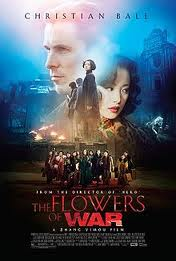
 The Flowers of War (2011) is directed by Zhang Yimou, China's best-known director (Ju Dou, Raise the Red Lantern) and based on the novel 13 Flowers of Nanjing by Geling Yan.  It is the most expensive movie made in China and paves the way for large international audiences.  It stars Christian Bale and Nanjing native Ni Ni (Yimou's latest "Mou" girl).  A beautiful soundtrack backs an impressive film about schoolgirls and prostitutes seeking safe haven in a Nanjing cathedral at the onset of the Nanking Massacre in 1937, under the protection of a mortician turned priest.

Tuesday, April 2, 2013

Beasts of No Nation by Uzodinma Iweala


"Uzo" Iweala  (U-zod-din-ma EE-wall-a) hails from a well-heeled Nigerian family, part of the vast diaspora situated in the U.S.  His father is a surgeon, and mother was Nigeria's Minister of Finance.  He wrote this story as a Harvard undergrad.  His grasp of native language is phenomenal.  The concept was born when attending a speaking engagement at Harvard by China Keitetsi, a young woman forced to fight in the Ugandan Civil War.  Most readers will imagine these lives as typical of the boy-soldiers of Sierra Leone.

As I began this magical little book, the lexicon of the 9-year old Agu struck me as a very powerful medium for telling the story of a boy forced to become a soldier, a killing machine.  His voice is "unliterary, yet poetic" (Baker, NYT 12/4/05).  The story is unimaginable without this voice.

It has precedence in Martin Amis' short story "What Happened to Me on My Holiday" in the collection Heavy Water.  Amis' story takes place in "Horzeleej Band" (Horseleech Pond, South of Wellfleet) and is narrated in an argot simulating his actual son, Louis, mourning the death of his step-brother.  The book is replete with onomatopoeia words like "TAKA TAKA TAKA," (p. 79) the sound of machine gun fire.  I am reminded of the Swahili term for motorcycle "piki piki piki," echoing the gentle sounds of a Honda 125 cc bike in the Tanzania bush.

The atrocities these boys are forced to commit are brutal.  "You are not my mother, I am saying to the girl's mother and when I am raising my knife high above my head.  I am liking the sound of knife chopping KPWUDA KPWUDA on her head and how the blood is just splashing on my hand and my face and my feets.  I am chopping and chopping and chopping until I am looking up and it is dark" (p. 51).  His commander is a pederast "Commandant is touching me and bringing my head to where he is standing at attention" (p. 84).  There's more: "he was telling me to kneel and then he was entering inside of me the way the man goat is sometimes mistaking other man goat for woman goat and going inside of them" (p. 85).  The man-boys are starving: "Everyone here is doing zero zero one.  I am not knowing what this is meaning before I am soldier, but now I am knowing that it means no breakfast, no lunch, only dinner" (p. 90).  Agu laments childhood lost: "I am knowing I am no more child so if this war is ending I cannot be going back to doing child thing" (p. 93).


Thursday, March 28, 2013

I Do Not Come to You by Chance by Adaobi Tricia Nwaubani

 
This is a page turner of a book and Nwaubani in I Do Not Come to You by Chance (2010) has been able to master a well written novel with great comedic style through caricature, something I have not seen in Nigerian authors.  Not unlike Noo Saro-Wiwa, her father was an activist, although Chukwuma Hope Nwaubani never paid with his life.  She was born in Enugu, grew up in Umuahia and has stayed in Nigeria, graduating from the Univ. of Ibadan, now living in Lagos after time spent in Abuja.  Got that?  The story takes place in Abia State and involves the Igbo tribe ("the niggers of Nigeria," pp. 234, 254) as does much Nigerian fiction. 
 
The title was inspired by Ecclesiastes 9:11.  "I returned, and saw under the sun,that the race is not to the swift, nor the battle to the strong, neither yet bread to the wise, nor yet riches to men of understanding, nor yet favour to men of skill; but time and chance happeneth to them all."  The author found the titular line from a '419' letter (p. 178) to an unsuspecting foreigner or "mugu" (p. 177).
 
It is interesting that this young woman writes a novel through the eyes of a young man, Kingsley Onyeaghalanwanneya Ibe.  He is an "opara" (pp. 15, 182, 376) the eldest son.  The author's name Adaobi means first daughter.  He loses his idealism and joins his Uncle Boniface aka Cash Daddy in a 419 Nigerian Letter scam.  The mugu is lured into various fees to be paid before he receives the big money, be it hidden money in a Swiss bank account or whatever. 
 
Ikhide Ikheloa (www.thenewblackmagazine.com) opines that the book 'reeks of rampant anti-intellectualism.  Cash Daddy chides Kingsley for his bookish aspirations. 
 
 The book is loaded with hilarity.  We learn that the National Electric Power Authority is best called Never Expect Power Always (p. 64).  "it felt as if 2,2,4-trimethylpentane had been pumped into my heart and set alight with a stick of match" (p.95) refers to the octane isomer used in octane rating.  Ben & Jerry's ice cream seems a staple of the 419ers (p. 145).  Kings' father relates the story of how the tortoise broke his back (p. 158), yet this fable already appeared in Adiche's Purple Hibiscus (2003), oops !  Kings notes that as Cash Daddy emerges from the shower "his five limbs were thick and long" (214).

Thursday, March 14, 2013

Two Years Before the Mast by Richard Henry Dana, Jr.


What was the first book written by an American author to be widely read overseas?  Dana's Two Years Before the Mast (1840).  There is also little doubt that it served as an inspiration for Melville's Moby-Dick (1851).  The character Sam Sparks (p. 81) had a speech impediment that may have been an inspiration for Billy Budd.  When "California 'broke out'...in 1848, and so large a portion of the Anglo-Saxon race flocked to it, there was no book upon California but mine" (p. 315).  I had been meaning to read this book since 1989, when I moved into a 1916 Colonial Revival house designed by Dana's eponymous great grandson, an Ecole des Beaux Arts architect of the Madison Ave. firm Murphy & Dana.

Dana was a student at Harvard in 1831, but measles left his eyesight weakened.  He joined the crew of the ship Pilgrim for a 2-year trip to California (actually Alto California, Mexico's northernmost state) around Cape Horn and documented the voyage in this seafaring adventure narrative.  Upon his return, he completed Harvard in 1837 and became a lawyer well known for defending the rights of the common man.  His chronicles of sailor life and the brutal floggings meted out by the Captain are the more memorable sections of the book.  He returned to California (now one of the United States) 24 years later in 1859 by steamboat and also chronicled that trip in a coda.  He died in Rome in 1882 and was buried in the Protestant Cemetery near the graves of Keats and Shelly.

The sea terminology is unparalleled.  I was well into the book before I realized that there was an illustration (fig. opposite p. 269) of the brig and ship sails with the names of each sail in the Great Illustrated Classics edition of the book.  The book gets it's name from the fact that the crew made their quarters in the forecastle (fig. opposite p. 10), before the mast.  Dana chose to live with the crew despite his elevated social status.  "There is not so hopeless and pitiable an object as a landsman beginning a sailor's life" (p. 2).  Many of the nautical terms are simple, like "hove," (p. 2) the past tense of "heave," to haul with a rope.  To "reef" (p. 5) a topsail is to fold and tie it down.  A "brig" (p. 14) is a two-mast ship with square sails.  A "hermaphrodite brig" (p. 15) is two-mast with only forward sales square.  The word "hazing" (p. 77) seems to be an old sailor term.  I even see the word "Yahoos" (p. 112).  "Doubling" (p. 266) is to sail around a projection of land as in doubling Cape Horn.

The geography from 1834 is fascinating.  The "Pacific well deserves its name, for...it has few storms" (p. 43).  At that time, Hawaii was known as the Sandwich Islands (p. 45).  Much of the book describes the natives - "The Californians are an idle, thriftless people, and can make nothing for themselves" (p. 62), yet "the climate as good as any in the world" (p. 68).  Boats from Sitka are coming down from Russian America (p. 188), under Russian control until 1899.  We learn that ships could take an inland route above Tierra del Fuego through the Straits of Magellan (p. 264).  It is interesting to note that the California Gold Rush broke out in 1848 in Alto California, statehood two years later (1850) was inevitable.


If you loved the book, the 1946 film (not yet on DVD) awaits, yet has little to do with Dana's story line.  Alan Ladd plays Charles Stewart (not in the book), son of the ship's owner and Brian Donlevy plays Dana (no mention of Harvard).  Mexican 1930s film diva Esther Fernández plays passenger and Ladd's love interest Maria Dominguez (most certainly not in the book !).  It's your basic swashbuckler and worth watching.

Sunday, March 3, 2013

Oil on Water by Helon Habila


Helon Habila is a new wave Nigerian author, presently a professor at George Mason Univ.  The novel Oil on Water (2010) follows two Port Harcourt journalists, Rufus and his mentor Zaq (dying of dengue fever, p. 150), into the Niger Delta in search of a kidnapped oil executive (p. 72) James Floode's wife, Isabel Floode (p. 191).  Of course, the kidnap assist is provided by her driver Salomon, and let's be clear that the executive has impregnated (p. 218) his girlfriend Koko (p. 202).  Naive he is too as he laments on the rebel attacks on the oil infrastructure "The people don't understand what they do to themselves..." (p. 103).

The story line aside, the style of writing is based on interwoven flashbacks, while our journalists are seeking the wife on Irikefe Island (imaginary, p. 225).  The book opens on "our ninth day on her trail" (p. 5).  Their odyssey is Conradian, and the flashback hazy style is reminiscent of Heart of Darkness.  Nigeria's dictator Sani Abacha (p. 236) died in 1998 - he was famous for colluding with Big Oil, this story unfolds ten years later.  Yet the triangular entanglements between rebels, the oil companies, and the Nigerian military are ever present.

Thursday, February 21, 2013

Half of a Yellow Sun by Chimamanda Ngozi Adichie


Biafran flag (sunrise)
Ogbunigwe land mine

Chimamanda Ngozi Adichie's sophomore effort Half of a Yellow Sun (2006) is an oeuvre of great gravitas, more so than any other African author I have read.  Achebe's simple yet powerful Things Fall Apart (the first sentence of the novel alludes to that work) and Okri's The Famished Road, a classic of magic realism, have been the gold standard for Nigerian literature.  With the Nigerian-Biafran War as a backdrop (1967-1970), the author has put a face to the conflict in a scholarly fashion.  In fact two of her grandfathers died in the war (frontispiece).  This was the war that made "Harold Wilson syndrome" (p. 338) or kwashiorkor the poster child of suffering.

The novel is narrated entirely from the point of view ("POV") of three of the leading characters: Ugwu, a 13 year old houseboy (p. 5), Olanna, his Master's (Odenigbo) wife, and Richard, lover to Kainene, Olanna's twin sister.  The reader only knows what they know, albeit sometimes limited.  The British Army has arrived "to finish us off" (p. 274) and "Lagos says Chinese soldiers are fighting for us" (p. 346).  The facts are never "authorially" approved.  We never hear from Odenigbo or Kainene. They are only observed from the outside.  For example, Olanna is brought news that Ugwu, press ganged into the Biafran army, has been killed.  We later learn he has survived.  Each chapter is told from a single POV, the leading word in each chapter is a character's name, the POV key.  Adichie crafts the POV very carefully.  just when you think she has slipped in chap. 26, Ugwu reveals that he "pretended not to have heard" (p. 293) Olanna and Muokelu talking in private !

Olanna Ozobia (p. 27) and Kainene are London School of Economics (pp. 40 and 57) graduates, the Igbo elite, Olanna beautiful, Kainene brilliant.  Kainene is lover with Richard, despite his repeated impotence (p. 63).

The book jumps around between events that took place during the early 1960s and the late 1960s in 4 sections.   This structure is used for dramatic effect, as two distinct acts of infidelity are revealed (pp. 231 and 234) to the reader well after the war is underway.  The war parties are tribal (p. 20), mainly the Hausa and the Igbo (referred to as the Jews (Holocaust reference, p. 50) of Nigeria due to racist attitudes).  The "Igbo were surly and money-loving" (p. 55).  The Igbo, under Colonel Ojukwu (p. 158), secede from Nigeria on July 6, 1967 (p. 161) to form the Republic of Biafra (named after the Bight of Biafra, p. 158).

There are 8 references to a book entitled The World was Silent When we Died, a work in progress (p. 374).  At first we ascribe it to Richard, yet he is not a finisher and we ultimately learn that Ugwu is the author (pp. 396, 433).

There is a healthy usage of the Igbo language.  Nkem means "my own" (p. 24).  "Speak with water in my mouth" (p. 226) means unheard.  An afia attack is to go behind enemy lines to buy food (p. 293).  An ogbunigwe is a Biafran land mine (pp. 317, 359).

Many English words are italicized, implying euphemisms, e.g., when Odenigbo uses the word experience (p. 186) and brief rash lust (p. 225).