Saturday, January 28, 2012

The Bellarosa Connection by Saul Bellow


This is Bellow's 2nd paperback-only novella. The Bellarosa Connection (1989) derives it's name from Harry Fonstein, a Galician Jew living in Italy under Mussolini, who is rescued from the Nazis "Hollywood-style" (p. 28) charitably by the real life impresario and lyricist Billy Rose (1899-1966), but misheard his name. The story is told by a nameless narrator, who is a child of Russian Jews from NJ (p. 2) and founder of an institute which teaches memory skills, the Mnemosyne (after mnemonic)Institute in Philadelphia. Fonstein is related to the Narrator as the nephew of his Aunt Mildred. The central plot is of Harry and his wife's (Sorella) effort to bring closure to their ordeal by meeting their disinterested benefactor. Ultimately, Sorella (whom the narrator likens to Rembrandt's Saskia (painting) stalks Billy Rose in Jerusalem at the King David Hotel and attempts to "blackmail" (p. 52) him with secret information, unsuccessfully.


Until late in the novella, the narrator fails to understand the Fonstein's desire for closure. "I break my head trying to understand why it's so important for Fonstein. He's been turned down ? So he's been turned down" (p. 22). The narrator wants to wash his hands of his own heritage "I didn't want to think of the history and psychology of these abominations, death chambers and furnaces. Stars are nuclear furnaces too. Such things are utterly beyond me, a pointless exercise" (p. 29). His "advice to Fonstein - given mentally - was: Forget it. Go American" (p. 29). The narrator has an odd comment to the portly Sorella, suggesting she is the living incorporation of European Jews: "Maybe Sorella was trying to incorporate in fatty tissue some portion of what he had lost - members of his family" (p. 48).

When Sorella meets Billy in 1959 (p. 58), she has a packet of evidence from Billy's deceased assistant Deborah Hamet (called Horsecollar (p. 16) because of Yiddish word khomet), accusing Billy Rose of bribing "Robert Moses' people to put across my patriotic Aquacade at the Fair" (p. 55) among other misdeeds (see photo 1939 World's Fair Aquacade).


For those wondering what the message of the book really is, perhaps it can be gleaned by assimilation concerns. Sorella says "if you want my basic view, here it is : The Jews could survive everything that Europe threw at them. I mean the lucky remnant. But now comes the next test - America. Can they hold their ground, or will the U.S.A. be too much for them?" (p. 65).


The 2nd half of the book (p. 66) is all about the narrator and his own memory loss. Years later in contemplation of the Fonsteins he no longer needs to see them because he remembers them so well : "My much appreciated in-absentia friends, so handsomely installed in my consciousness" (p. 72). In a dream sequence (p. 89), the narrator finally understands the Fonstein's quest for closure. The final words of the book betray the shallow thinking of the narrator: "I chose instead to record everything I could remember of the Bellarosa Connection, and set it all down with a Mnemosyne flourish" (p. 102). This was merely a check on the vitality of his own mental powers, rather than an exercise in emotional memory.

Saturday, January 14, 2012

A Theft by Saul Bellow


This novella, divided into 6 unnumbered chapters, was intended for a magazine, but none would publish it, so Bellow published it in 1989 as a paperback only. The plot is simple. Clara Velde is a successful fashion writer in New York City living on Park Ave. amidst a city in an era of moral and financial bankruptcy - she refers to NYC as "Gogmagogsville" (p. 12), from Satan's warring kingdoms Gog and Magog. Oddly, the protagonist is not male and not Jewish ! The book's title refers to the disappearance of Clara's prized emerald ring. Clara associates the ring with her love for the Washington, D.C. politico Ithiel Teddy Regler and with her own professional and personal power. With 7 marriages between them, they are "permanent" (p.) lovers and the ring was a gift, bought at Madison Hamilton (47th St.) (p. 40), from Ithiel (the name can be translated as "God with me"). The ring's apparent theft leads Clara into a series of psychological crises and forces her to confront a long-buried complex of interpersonal issues. Unlike most Bellow protagonists, she doesn't "take much stock in the collapsing-culture bit" (p. 89).

Clara is a romantic who believes that "you couldn't separate love from being" (p. 31). Regarding Ithiel "I love you with my soul" (p. 33). The emerald ring "represented the permanent form of the passion she had for this man" (p. 43). She equates the emerald as symbolic of the inner mines of her body and states "I am an infant mine" (p. 43) referring to the gems her 3 daughters would be.


Gina Wegman (p. 45) is an Austrian au pair with a Haitian boyfriend, Frederic Vigneron (p. 82), who steals the ring while exploring Clara's apt. The theft is symbolic of theft of our humanity by civilization (East & West) that we have created. Ultimately, Gina explains the significance of the heirloom to her Haitian and returns it by convincing the youngest daughter Lucy ("There's something major in Lucy") (p. 47) to secretly return it to her mother's night table (p. 83).


In the end, Clara has an epiphany-like moment, reminiscent of Seize the Day, where she feels at one with the surrounding humanity (she calls herself "homeless" (p. 109)). She is most overwhelmed by the goodness of her 10-year old daughter.

Sunday, January 1, 2012

Him With His Foot in His Mouth by Saul Bellow


Large sprawling novels are better suited to revealing the masterly writing of Saul Bellow than short stories. That being said, this collection that spans a decade before publication (1984) is well worth reading. There are many little gems to be found.

Him With His Foot in His Mouth (1982). This story is a draft letter (p. 4) of apology to a Miss Rose, a librarian at a New England college, for an unwarranted rude remark made to her many years ago by one Herschel Shawmut (p. 31), narrator. Miss Rose said that he looked like an archaeologist in his cap, and he replied that she looked "like something I just dug up" (p. 8). The letter introduces subjects far beyond the scope of the apology. He is living in British Columbia to avoid being sued for a financial swindle perpetrated by his brother Philip. An italicized "Personal Note" infers that this draft letter is more of an apologia to unnamed readers rather than an apology to Miss Rose. The blurred and rambling letter implies that the narrator merely wants to listen to himself: "The writing of this letter has been the occasion of important discoveries about myself" (p. 57).


What Kind of Day Did You Have (1984) is the story of Katrina Goliger, divorced, who is summoned to Buffalo from Evanston (Illinois) by her septuagenarian lover, Victor Wulpy, to share a plane ride back to Chicago. She sets aside her "self-respect" (p. 64) and drops all to make the trip. Victor is a "world-class intellectual" (p. 63) and expert in art, modelled after Bellow's friend Harold Rosenberg. Victor is still a sexual player and has "a silken scrotum that he might now and then...be touching, leading out the longest hairs" (p. 73). Such a Bellow-ism !And more, Victor called her hands "her touch-cock fingers" (p. 104). Victor senses a Baudelairean phase of their relationship and quotes the Chanson d'Apres-midi from Fleurs du mal: "....tu connais la caresse Qui fait revivre les morts..."


Much of the story is tied up with a chance meeting with Larry Wrangel in Buffalo (then again in Detroit when snow forces an unscheduled landing), who challenges Victor (p. 115) on his dealings 30 years earlier with Pavel Tchelitchew, a neo-Romanticist painter (his famous "Hide and Seek" painting in photo). Katrina is "daunted" by Victor's "intellect, she casts herself in the role of his pupil, paying erotic tuition happily for the privilege of sharing his conversation" (p. 197). She wears ostrich-skin boots (p.88), a metaphor for her retreat from conventional life. She has "been trying to write a children's story about an elephant" (p. 86), that takes the elevator to the top floor of a department store, where toys are sold, but refuses to get back on to leave (p. 91), symbolic of her own "elevated" position with no egress. Upon returning home she exclaims to her daughters Soolie and Pearl "What kind of day did you have ?" (p. 161) a question that would be unanswerable were it addressed to her.


Best lines - "'He runs a Procrustean flophouse for bum ideas'" (p. 77) [Procrustes amputated limbs of travelers to conform to the length of bed in his inn]. "To read Beidell's mind you'd need a proctoscope" (p. 99). "Even Vespasian when he collected his toilet tax had to justify himself: Pecunia non olet. But we've come to a point where it's only money that doesn't stink" (p. 109.

Zetland: By a Character Witness (1974) is really about Bellow's childhood friend Isaac Rosenfeld, who died at age 38, which explains a rather abrupt ending. It is a story about how father (Max) and son (Zet) do not see eye to eye about what defines a successful career and how greener pastures do not always lie ahead. Best word - Schwärmerei, meaning excessive sentimentality.

A Silver Dish (1978) is the best short story in the book, based on the subtle games Bellow plays with the narration as well as the symbolism. It is about a 60 yr old (pp. 191, 203) son Woody Selbst and his octogenarian (p. 191) father Morris and the son's reluctant realization of how different they view the world. In the end he attends his father's funeral at age 83 (p. 221). Throughout the story, the narrator attempts to maintain a specious anonymity, but in his enthusiasm reveals that he is indeed Woody (the word "selbst" is self in German). The book opens with narration that betrays emotional involvement and then disjointedly becomes more distant ("Morris, his old man")(p. 192). At one point, the narrator jumps in and speaks in his own voice ("But Pop!")(p. 201). His omniscience becomes a charade.

The story subtly and suddenly recounts a story (p. 201) that took place 40 (pp. 193, 216) years ago. Woody consents to let his father ask Mrs. Skoglund for money (p. 202), she had been paying for his seminary education. To Woody, "Pop was elemental", He wanted what he wanted when he wanted it" (p. 206). "In regard to Pop, you thought of neither sincerity nor insincerity" (p. 206). Woody is the typical Bellovian protagonist who suffers internal dividedness. The story reaches its crescendo when Pop steals a silver dish from Skoglund. He stuffs it in his pants, inside his underpants. For Woody, "it was impossible to thrust his hand under Pop's belt to recover the dish" (213). Woody, at 2o, fails the Oedipal coming-of-age test, contemplating his father's paternal genitalia buried within the vaginal dish. Nevertheless, Woody tussles him to the ground, afraid "the old man was about to bite him" (p. 213), triggering the narrator's memory of a crocodile in the Nile eating a buffalo calf (p. 192) near the Murchison Falls in Uganda. Ultimately, Ms. Skoglund discovers missing heirloom and Woody is suspended from divinity school (p. 216). In effect "Pop had carried him back to his side of the line" (p. 217) forcing the dismissal.

Woody spent a lifetime emulating his father's bad ways, as Kiernan (Saul Bellow) observes: Pop was abandoned by his parents at age 12, Woody bankrolled his own desertion by 14. Pop cheated and stole as a young man, Woody stole bacon. Pop showed the moral indifference of a Mongolian bandit (p. 213), Woody treasures memory of smuggling hashish, pimping for prostitutes. Pop abandoned his wife and children for another man's wife, Woody keeps 3 residences for himself, wife, and mistress. But fundamentally, they were different. The last sentence betrays Woody's feelings towards his father "That was how he was" (p. 222), not the way Woody was.

Cousins (1984) is a short story that draws in the Bellovian themes of dividedness and alienation in a big way. It is very challenging, hard to imagine a full comprehension on a single reading, the reread is filled with epiphanies. One needs to understand the basis of Hegel's Lectures at Jena (1806) and drill down a bit on the Jesup Exploration of the Siberian Eskimos. Ijah Brodsky, the narrator, explains that "I don't practice law, don't play the piano. don't do any of the things I was famous for (with intramural fame)" (p. 265), although he emceed the famous-trials TV show (p. 227) for many years. He has two passions: He keeps "track of all the cousins" (p. 233) and reading the "reports of the Jesup Expedition" (p. 258).

There are a lot of moving parts in this story, but the pending incarceration of his crooked cousin Raphael (Tanky) Metzger is played off against the imminent death of his intellectual cousin Scholem Stavis. Tanky (he was built like a tank on his high school football team (p. 238). Ijah's parents' generation includes his mother Shana, father Red, Shana's brothers Mordechai (Motty) and Shimon. Tanky's sister Eunice contacts Ijah to help bail him out of a harsh prison sentence by writing the Judge.

Bellow lifts famous lines from Hegel's final lecture in Jena. He states that the "whole mass of ideas that have been current until now 'the very bonds of the world,' are dissolving and collapsing like a vision in a dream. A new emergence of Spirit is - or had better be - at hand" (p. 246). And where, with regard to the cousins, does that leave us?...I can't sail forth; I can't even extricate myself from the ties of Jewish cousinhood. It may be that the dissolution of the bonds of the world affects Jews in different ways" (p. 246). Ijah sees himself as an anachronism.

Keeping in mind that Bellow was an anthropology student at Northwestern, Ijad is obsessed with reading Boas' monographs on the 1906 Jesup Expedition to study the Koryak and Chukchee tribes in Siberia, as described by Waldemar Jochelson and Waldemar Bogoras. The narrator mentions these Russian Jews were political radicals (p. 252) that were exiled to Siberia in the 1890s (p. 253). Franz Boas (p. 255) at the American Museum of Natural History requested Moscow to set them free. This grant of freedom is in direct contrast to Tanky's request for release, and conjures images of human brotherhood. The studies revealed that the Chukchees buy protection from demons like mobsters pay tribute to the Mob (p. 253). Shamans (p. 253) offer the protection. Ijah sees himself as seerlike (p. 254), predicting "the revolution of the mullahs" in Iran.

Hegel gets mixed in to the discussion: "And whether we are preparing a new birth of spirit or the agonies of final dissolution...depends on what you think, feel, and will about such manifestations or apparitions, on the kabbalistic skill you develop in te interpretation of these contemporary formations. My intuition is that the Koryak and the Chukchee lead me in the right direction" (pp. 253-254). Ijah doubts that this world is on the brink of rebirth of spirit. Ijah now introduces his cousin Ezekiel (Seckel) who lectured in primitive languages at the state university. He learned dying languages of the Mohicans in Michigan. "He described himself as a Diffusionist. All culture was invented once, and spread from a single source" (p.256). His belief precludes optimism about the future, Seckel identifies with obsolescence. Ijah sees a universalism among peoples, as the Siberian tribes behaved in ways that defied their harsh environment rather than adapting to it. These trends apply to his Jewish cousinhood as well, as he is informed by anthropology as well as metaphysics.

In a beautiful passage, he reflects as a boy "how geography had been taught in the Chicago schools when I was a kid. We were issued a series of booklets: 'Our Little Japanese Cousins, 'Little Moroccan Cousins,' 'Our Little Russian Cousins,' 'Our Little Spanish Cousins.' I read all these gentle descriptions about little Ivan and tiny Conchita, and my eager heart opened to them. Why, we were close, we were one under it all....we were not guineas, dagos, krauts; we were cousins" (p. 292). Despite confrontation with horrifying chaos, the narrator emerges with profound insight on the universal nature of human beings.

The book closes with the pending death of Scholem Stavis, who is a brilliant philosopher, forced to drive a taxi. Ijah meets him at a taxi convention in Paris, and makes arrangements to honor his request to be buried in East Germany. He receives a letter from Eunice (p. 291) regarding Tanky's additional wishes, he tears the letter up and makes a moral choice to ignore this request and focus on Scholem. Ijah's final thoughts - "I had remembered, observed, studied the cousins, and these studies seemed to fix my own essence and to keep me as I had been. I had failed to include myself among them, and suddenly I was billed for this oversight" (p. 294). His studies have been a means of retaining his division and separateness.

Tuesday, December 13, 2011

Rock the Casbah by Robin Wright


The Ventriloquist's Tale by Pauline Melville


Maya Jaggi (The Guardian, 1/1/10) notes that "the imaginative power to inhabit others' lives, and ventriloquise voices, nourished Melville's early life as an actor and stand-up comic." Her pre-school years in the 1940s were spent in the colony of British Guiana. Her father was "mixed-race Guyanese, part South American Indian, African and Scottish", and her mother came from a "big working-class family" in south London. They had met in Cuba while her mother was on a break from working on the Canadian railways. The family (she has two sisters) moved to south London in the early 1950s, when she was "five or six". Her father, who worked for a sugar company, fell ill with tuberculosis, spending long spells in a sanatorium. Melville had TB as a teenager. "I hadn't known my father had it; in England it was a great disgrace, to do with poverty and immigrants."

She spent time with relatives in Guyana's Rupununi savanna, a remote region near the Brazilian border peopled mainly by Wapisiana Indians, where her part-Indian ancestors were well-off cattle ranchers. The Ventriloquist's Tale (1997) was partly a riposte to Evelyn Waugh, whose travels in British Guiana in 1933 fed A Handful of Dust. In an afterword in 2007 to Waugh's travelogue Ninety-Two Days, Melville recalled her indignation at his scorn for the "nauseating hospitality of savages" – one of whom saved his life. Waugh mentions a Mr Melville, of white Jamaican-Scottish ancestry, who settled down with two Wapisiana sisters as wives, and had 10 children. Waugh's diaries also refer to a "dotty bastard nephew, son of John Melville by his three-quarter sister." That hint of incest among her forebears lies at the heart of the novel. She recently spent years compiling a Wapichan dictionary with a cousin, aware of "how extraordinary the translations are – the word for snack is 'liar', because it lies to your stomach that you're full. It's being overwhelmed by English, and is likely to die out."


Barzotto and Bonnici analyzed the novel, with special focus on transculturation. They appear to incorrectly associate the narrator with Wifreda, rather than Sonny (the Prologue reveals that the narrator handles narration for the whole novel). They summarized the action of a story that takes place in 1919:

The story describes the life of Chofy McKinnon. Chofy is a poor farmer, aged forty, resigned to his monotonous life and marriage. When he goes to Georgetown with his old aunt Wifreda, who needs an eye operation, he meets Rosa Mendelson, an English scholar who is doing research on Evelyn Waugh (1903-1966), a British writer who visited British Guyana in 1933. Rosa is delighted to learn that Chofy’s aunt had met Waugh, and she is even more pleased when she realizes she can combine her literary research with a satisfying sexual relationship with the passionate Chofy. Differences in culture and background, however, prevent Rosa and Chofy from achieving intellectual as well as sexual harmony.

The second part of the story is told in a non-chronological way because it is a flashback by Wifreda’s stream of consciousness while recovering from her eye surgery. In fact, Wifreda is becoming blind, superstitiously attributed to Beatrice’s curse because the former has discovered her incestuous relationship with her brother.

Auntie Wifreda starts to remember her past life in the Waronawa region, and everything that happened in her Indian village. Wifreda is Zuna’s daughter. Maba and Zuna are full sisters and they are married to the same white man: Alexander McKinnon, a lean and energetic blue-eyed Scotsman in his 30s. McKinnon arrives in the Indian village via Jamaica where he was raised. On the way he feels ill and is abandoned by the Indians in the middle of the forest.
He finds the Wapisiana river village and Maba takes care of him, teaches him the Wapisiana language, and marries him. Photography is his great passion and pastime.

McKinnon married Maba and later Zuna, her sister. After having many children (Danny, Beatrice, Alice, Freddie from Maba, Wifreda from Zuna) they still cohabited in a peaceful way since McKinnon appreciated that wild style of life. Beatrice and Danny, sister and brother respectively, had an incestuous relationship and an autistic baby was born (Sonny). They ran away from the tribe and after being found they were separated forever. She went to Canada and he married a Brazilian girl. The baby was left to Wifreda and one day he mysteriously disappeared.

After more than two decades, McKinnon decides to leave the village and returns to Scotland. He abandons his wives and the children. Later on, it is said that he married a Scotswoman and ‘reshaped’ his European personality to erase his previous life among Amerindians. Wifreda continues to live with her husband and children and raising people’s children in her husband’s
village. Chofoye returns to his wife after seeing his son, Bla-Bla, killed by a bomb explosion in an accident caused by the American who were invading the territory for oil. After that, all the McKinnons fly back to the Rupununi. Auntie Wifreda recovers her sight. In the meantime, Rosa returns to England and feels terrible without Chofy beside her. Life in the Rupununi goes to normality again.

Wednesday, November 2, 2011

The Dean's December by Saul Bellow


The Dean's December (1982) fits squarely into the period defined as "late Bellow." It is Bellow's first book after his Nobel Prize. It has been called simultaneously magnificent and dull. It is a tale of two cities, Bucharest and Chicago, emblematic of irreconcilable differences between East and West. It's protagonist Albert Corde, half Huguenot and half Irish (p. 129) is a newspaperman who has become a professor of journalism and then Dean of an unnamed Chicago college (although Univ. Chicago and Northwestern are named in the novel (p.303)). He has written, in apocalyptic fashion, a series of articles in Harper's indicting Chicago for its racism and lack of "moral initiative." He has also pressed for the conviction of a black man who murdered one of the college's white students, Rickie Lester. His impulse to take absolute moral readings leads to his dismissal as Dean.

Meanwhile he and his wife Minna (astrophysicist) spend December in Bucharest, attending her dying mother Valeria Raresh, suffering a stroke (p. 7), distinguished psychiatrist. Rumanian officials obstruct their visits because of Valeria's history of disdain for the Socialist government. Minna defected from Rumania 20 years earlier. Valeria dies on Christmas Eve. Dewey Spangler, Albert's childhood friend, happens to be in Bucharest, now an international journalist, who fancies himself a Walter Lippmann, a Pulitzer Prize winning (twice) journalist who coined the term "Cold War." Corde inadvertently grants Spangler an interview, which is printed and damns him with "an earnestness too great for his capacities" (p. 300), forcing his resignation. The novel ends with him accompanying Minna to Mount Palomar observatory. He rides a lift with her, following its curve to its apex, then returns to the floor aware of this obvious analogy to his fall from moral authority.

Kiernan (Saul Bellow) points out that the protagonist is concerned with "connections" (p. 32) between opposites - with cords that bind, as his surname suggests. This manifests itself in a dialectical approach to experience. He seeks experience of an alternative kind in hope of discovering some ultimate synthesis. As a Tribune reporter with an international reputation, ha abandons a career others would envy and seeks seclusion in academe. Once dean, he devotes himself to muckraking journalism that embarrasses the college. After establishing such liberal credentials he makes a crusade of bringing a black man to justice, leaving himself open to charges of racism.

Corde's ailments are clear to others. Provost Alec Witt (smart alec and academic wit) feels he's simply a fool who has to be led by the nose through his academic duties. Corde ultimately agrees that his Harper's articles were unwise, desiring to rewrite them from a larger perspective. Childhood friend Spangler is "damned if I can explain why you wrote those pieces" (p. 115). He sees Corde's trajectory as going "from active to passive" (p. 117) - "Now you're tired of the passive and you've gone hyperactive, and gotten distorted and all tied in knots" (p. 117). Spangler hints at Stygian perversities and says that Corde "might as well have stirred Bubble Creek with a ten-foot pole and forced the whole town to smell it" (p. 115). Bubbly Creek is a portion of the Chicago River where blood and entrails were dumped by local stockyards in the early 20th century leading to bubbling of methane and hydrogen sulfide and brought to light by Upton Sinclair's "The Jungle."

Corde's cousin Max Detillion (Detillion has cheated him of $200,000, thereby "debt"-illion) chooses to represent the defense in the murder trial that proves Corde's undoing. Detillion and Corde's deceased brother-in-law both see him as H.L. Mencken's Boobus Americanus. Zaehner's son Mason, college dropout, friend of the accused, appoints himself the Dean's harshest critic. Mason views his uncle as a racist, titillating himself with the observation of lives darker than his own (like Charlie Citrine in Humboldt's Gift). He thinks Mason's voice "the true voice of Chicago - the spirit of the age speaking from its lowest register" (p. 41). Not all his male cohorts are detractors. Beech, an eminent geologist, invites him to write about his discovery that crime in inner-city populations can be traced to the effects of lead poisoning - to be his interpreter to the "Humanists" (p. 134).

Kiernan observes Bellow counters his gang of male Chicagoans with a cluster of East European women. Valeria anchors the group with her daughter Minna, her sister Gigi, Beech's Serbian assistant Vlada, and Valeria's concierge Ioanna - all forming an "extended feminine hierarchy" (p. 72). Corde has a special regard for Valeria - he tells her he loves her on her deathbed causing her to suffer a galvanic seizure. He knows his history as a womanizer has troubled Valeria. Her last gift to Corde was an antique pocket watch, an emblem of time running backwards (p. ). Corde views his relation with his own wife as manager of her "sublunary" affairs (p. 258). Yet an unbridgeable gulf yawns between the temperaments of mean and women, as between "Eros and Psyche" (p. 257). Corde involves himself with the terra firma of history and politics, Minna, with boundless space; and each find's the other's pursuit incomprehensible. Because she separates her scientific and humanistic perceptions, Corde admires Minna less than Valeria. Corde's "hypnotic coalescence" (p. 91) with Minna and the community of women finds its emblem in the cyclamens (photo and dust jacket) that bloom luxuriantly in the chill air of the Bucharest crematorium. Corde recalls that the plants produce their leaves and spectacular flowers in a state of sleep - that they represent "perfection devoid of consciousness, design without nerves" (p. 55). Corde takes his cue "from them and gave up consciousness" (p. 57) and goes into a "state of blankness" (p. 133), suggesting an unsleeping sleep of the cyclamens. Kiernan: he enters, apparently, a state of consciousness life suited to hypnotic coalescence, and he comes to fulfillment in that state as mysteriously and as magnificently as the flowerless plants.

Kiernan notes the domes (Valeria the crematorium, Minna the observatory) of the novel are also emblematic of the coalescence with Minna and the community of women. For Corde, both domes are inhospitably cold. Corde is brought lower by attendants, to the hot nether regions of the crematorium, where he identifies Valeria's body and to the warmer floor of the observatory, away from the freezing heights where he leaves Minna.

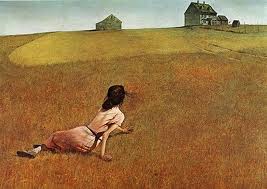
Kiernan observes that Corde tries to make physical perception a vehicle of humanistic understanding. His endeavor can be compared to the Sharp-Focus Realists in modern painting. Like the exaggerated clarity of Andrew Wyeth's Christina's World (photo), Corde's intensity of observation produces a sense of signification rather than explicable meanings. In demanding coherence of a divided world, Corde seeks an idealistic enterprise. Bellovian man enters as Corde finds no possibility of synthesis being real without his perceiving it. "Reality didn't exist 'out there'....It began to be real only when the soul found its underlying truth" (p.263). Rather than relax into dividedness, he seeks to resolve opposite opinion into ultimate truth.

In the final scene of the novel, Corde takes the lift back to the ground, and says to Minna "The cold? Yes. But I almost think I mind coming down more" (p. 309). That "almost" is all that stands between Corde's reluctance and his readiness to resume his role in the world below.

Friday, October 28, 2011

Wild Coast by John Gimlette


John Gimlette has written a well researched book on "The Guianas" (p. 5) comprised of Guyana (formerly British Guiana), Suriname (formerly Dutch Guiana) and Guyane Française (also known as French Guyana). The Guianas lie between the great rivers of South America, the Orinoco and the Amazon. Between these boundaries, over 40 other rivers exist, none navigable more than 90 miles. Once upon a time, sugar cane was king, and created inestimable wealth for Great Britain, Holland, and France. The slaves exploited for this enterprise would rewrite the history books in early abolition efforts. Gimlette's travels originate in Guyana and head east through Suriname to the Guyane/Brazil border. He often jumps between historical details and his present-time travelogue, on the turn of a dime. Most of the book is devoted to Guyana, with much focus on Jonestown and the southern savannah called Rupununi.

Georgetown is given short shrift, despite being a World Heritage site, but we learn some interesting facts, e.g., a "European had to have twenty-five slaves in order to vote" (p. 26). A chapter is devoted to the 1978 Jonestown massacre, an event which really had nothing to do with Guyana, "It was an American matter" (p. 82). The author pays great attention to the Rupununi Savannah in the south of Guyana, below the Rain Forest. He quotes Evelyn Waugh's book 92 Days, who was underwhelmed by a visit in the 1930s, sampling "every variant of Guyanese discomfort: fevers, saddle sores, boils, rashes, 'deep and tenacious' ticks, and bites 'like circles of burning flesh'" (p. 89). He visits a famous resort "Rockview" (p. 89) which had a pet tapir. He mentions Waterton's discovery of curare for blowpipe tips (p. 104). The waterways were filled with nasty critters, not just caymans, but "a vast society of flesh-eating beasts" including "the nine inch perai", "stingrays and electric eels - the 500-volt variety" (p. 106). Land critters also abound, including the labaria, a deadly snake (p. 160). The Guyana section wraps up with Berbice, center of a massive slave revolt in 1763. The Dutch have not forgotten and have an "expression: 'Naar de Barrebiesjes gaan' ('Get thee to Berbice '), the equivalent of "go to Hell'" (p. 171). Berbice nearly became South America's first and only republic of slaves (p. 176). Guyana abounds in old wooden architecture, like the dilapidated 1881 hospital in New Amsterdam (see photo).


Ah, mysterious Suriname, autonomous since 1975. What other country has a banknote for 2 1/2 dollars (photo)? In 1650, the Dutch thought they were clever and swapped the island of Manhattan for Suriname with the foolish British ! After all, "nothing grows up north" (p. 192). Much of Suriname's history revolves around the runaway slaves or "maroons" (p. 202). Suriname had become a "byword for brutality in the name of profit. In Candide, published in 1758, Voltaire's hero arrives here to be robbed by judges and sea captains, and to meet a slave whose been shorn of his limbs...Candide finally renounces his faith in Providence and decides to head for home" (p. 203). Ultimately, the maroons signed a treaty for their freedom. It is glossed over in the book: "It was another five years before the Saramaccaners signed a treaty" (p. 203). Other tribes were among the macaroons: "the Kwintis, N'Djukas, Bonis, Paramaccaners and Matawais" (p. 205). Maroons spoke a form of Creole or "Talkie-talkie" (p. 208).


Most interesting is the recounting of the tale of John Gabriel Stedman who was brought in to lead the quelling of a slave revolt in 1771. Ironically, he became a sympathizer to the slaves and wrote a famous abolitionist treatise Narrative of a Five Years' Expedition against the Revolted Negroes of Surinam, in Guiana on the Wild Coast of South America in 1790 (p. 261). It was so explicit, that Stedman feared for himself and burned thousands of copies rather than sell them. In this century, V.S. Naipaul called it a"a nauseous catalogue of atrocities" like those about the Nazis (p. 262). It was recently published by the Johns Hopkins Press in 1988, when Richard and Sally Price found the original drafts.


Which leaves us with Guyane, still a department of France. Historically a penal colony since 1848, this country is perhaps best known to the outside world for the film Papillon, about inmates on Devil's Island. That island, St. Joseph, and Royal Island made up the Iles du Salut (Salvation). The likelihood of prisoners dying in French Guyana was so great that banishment became known as la guillotine sèche, the chop without the mess. The rule of doublage (p. 300) required that every man serve the same period again as a 'free' man in the colony, each man expected to support himself. The Dreyfus Affair was the swan song of the penal colony, when a Jewish Captain was suspected of leaking secrets to the Germans. Dreyfus was sent to Devil's Island in 1895 at the age of 36. The French novelist Emile Zola is outraged and publishes his famous letter 'J'accuse' in 1898. Dreyfus returns to France a year later. His legacy includes formation of the World Zionist Organization as Herzl was inspired by the case. Devils Island continued to house enemies of France including the Việt Quốc in 1931. In 1938, no new inmates were imported as a result of world outrage. After the war, France offered Guyane as a homeland for the Jews and also planned to provide shelter for DPs (Displaced Persons) (p. 315).


Strange as it may seem, since 1968, Guyane is also the site where 50% of commercial satellites are launched (p. 317) from the Centre Spatial Guyanais in Kourou. Launches from the equator are advantageous for geostationary satellites due to the increased velocity of the earth's rotation.