![]() |
| Hsiang-ya Hospital, Changsha, Hunan |
Saturday, January 31, 2015
Saturday, April 12, 2014
Boulevard of Dreams by Constance Rosenblum
Before the Bronx was a Borough (1895) or a County (1915) it was part of Westchester County, one of 12 counties in NY State set up by the British. Manhattan, hungry for new land began annexing lands surrounding in the 1890s, including ample Park space in modern day Pelham Bay Park, Bronx Park, and Van Cortlandt Park. Unfortunately, there was no simple access to those parks, until a "speedway" (for horses) was proposed in 1892 along a north-south ridge from the Harlem River to the Mosholu Pkwy. The inspiration for a Bronx-style Champs Elysses was a French immigrant engineer Louis Risse. Legislators approved the road in 1895, and took title to properties by 1898. It was not completed until 1909. It was the first urban thoroughfare to incorporate underpaasses.
Saturday, January 11, 2014
Gold Boy, Emerald Girl by Yiyun Li
Yiyun Li began writing short stories in America in her adopted English language, not unlike Ha Jin. She is a favorite author of Amy Tan and is considered a feminist writer. She became a MacArthur Foundation fellow in 2010 and teaches at UC Davis.
Gold Boy, Emerald Girl (2010) followed her novel The Vagrants. In "Kindness", an unmarried woman, Moyan, recollects her closest relationships, a friendship with a Professor Shan, who loves English novels, Lieutenant Wei, a female army officer, and a brief crush on a man who moved out of her neighborhood. The English teacher reveals to Moyan that she is adopted (pp. 13, 73) and her mother was a nymphomaniac (p. 21). In the Army, a friend asks her to translate the sexy passages in Lady Chatterly's Lover. "I blushed at the words she used - zuo-ai, doing love, an innocent yet unfortunate mistranslation of the English phrase making love" (p. 31). Inevitably, her lieutenant catches her with the book under the bedsheets (p. 39). It is the death of Wei (p. 4) that motivates the narrator to tell her story. At one point, Moyan develops a brief crush on a neighbor. Shan comments "The moment you let someone into your heart you make yourself a fool...when you desire nothing, nothing will defeat you" (p. 39). A sad commentary at best.
Li says she wrote this story as an homage to William Trevor:
I opened the novella with three sentences that echoed the opening sentences of Nights at the Alexandra, and while writing it, I imagined my narrator speaking to the narrator in Trevor’s novella – both characters lead a stoically solitary life, yet both are capable, and are proofs, of love, and affection and loyalty. Their conversation would not have happened in reality, but I hope that by speaking to one person in her mind, my narrator, in the end, speaks to many."A Man Like Him" concerns a celibate Teacher Fei (who "never cupped his hands around a woman's breasts," p. 91) who offers to assist a man wrongfully accused of adultery by his daughter, who exploits the Internet to seek revenge. Fei's father had committed suicide (p. 89) and Fei gave his mother every chance to do the same (p. 90). Fei's teaching career was ruined by a few moments of gazing (p. 98) at a female student, an indiscretion that branded him a pedophile (p. 99). The Chinese character with the sound Fei means to give up or abandon - both these men have lost their livelihoods due to alleged wrongdoing for which they have no control.
In “Prison,” a Chinese couple (Yilan and Luo) living in America lose their 16-year-old daughter in a traffic accident (unintended suicide) and find their world shattered. They go to China and find a surrogate mother so that they might have another child. The wife chooses an uneducated young woman (Fusang) whose only child has been stolen by a kidnapper several years before, and stays with her during the pregnancy with twins, fretting over imagined dangers to the unborn children. When the two women are approached by a young beggar boy on the street, the pregnant woman insists that the boy is her missing child (p. 125). When the two women get home, the girl demands that the woman give her half the money promised so that she can buy the boy back from the beggar man. When the woman asks the girl to sit down so they can talk about it, she threatens to run away and sell the twins. The story ends with a standoff as the woman thinks, “This was the price they paid for being mothers…that the love of one’s own child made everyone else in the world a potential enemy.” She knows that the relationship of trust she and the girl has developed during the pregnancy is crushed and that they will remain each other’s prisoners (p. 130).
In "The Proprietress," Mrs. Jin is the owner of a small general store in Clear Water Town. Even though she sells goods to the poor people of the village, her most important activities have little to do with her store. Her home is next to a county jail and is a safe haven for "adopted" women of all ages. Among whom is Susu, a woman who recently caused an uproar when she asked the courts to allow her to have a child with her husband before he was executed. Her request makes Susu nationally known, so much so that a reporter from Shanghai comes to Mrs. Jin’s shop to ask her a few questions.
Sunday, August 4, 2013
Taipei by Tao Lin
Tao Lin has earned the reputation as the Bad Boy of Indie novels or Alt Lit (wedded to culture of the Internet and self-publication), but can he sustain that claim now that main line publisher Vintage has published his latest autobiographical crossover novel Taipei (2013) ? The book cover is notable as an animated GIF transferred to holographic foil. It is a love story about Paul, a Brooklyn novelist anticipating embarking on a book tour "September 7 to November 4" (p. 93). We know it was "twenty months ago" (p. 90) when Paul first learned of budding love interest Erin, in "January 2009") (p. 90), placing the action (or lack thereof) in August, 2011. The vocabulary is minimalist: Stephen Marche of Esquire calls it the "Asperger's style" of literature based on disaffection and disconnection.
This novel was trashed by Lydia Kiesling in her review "Modern Life is Rubbish: Tao Lin's Taipei" in the online literary magazine The Millions, founded by Max Magee in 2003. Her review resonated on the Internet. She wonders "why someone who hates words would take the trouble to arrange so many of them in a row...Why does he hate me ?...Why does he inflict upon me his framework-y (p. 8) somethingness, his soil-y (p. 11) area, or the salad-y (p. 21) remains of the burrito?" The author seems to be embarrassed by words and what they can represent and mean. His are colorless, witless, humorless. "Picking out individual passages cannot express the cumulative monotonous assault on the senses."
LK notes that everyone's ages are "recorded, as if in a hipster police blotter, a method to describe people without really describing them." LK sees the drug use as a good excuse for its awfulness, because it now had a Problem. She also points out regarding sex in the book that "when the panties come off, the camera, narratively speaking, looks politely away." Sex is awkwardly clinical, witness "At Paul's apartment they drank green juice and showered, then performed oral sex on each other, showered again, turned off the light to sleep" (p. 216).
Kiesling feels that Tao Lin anticipates the backlash in Taipei. “He read an account of his Toronto reading, when he’d been sober, describing him as ‘monosyllabic,’ ‘awkward,’ ‘stilted and unfriendly’ within a disapproval of his oeuvre, itself vaguely within a disapproval of contemporary culture and, by way of a link to someone else’s essay, the internet” (p. 129). Wow, TL writes his own book review ! Yet in a June 9 comment to Kiesling's review, a reader compares Lin the superrealist attempting to do with writing what photographers do on film: capture what is. TL bears out this notion on the last page: Paul "briefly discerned her movement as incremental - not continuous, but in frames per second - and, like with insects or large predators, unpredictable and dangerous" (p. 248).
Clancy Martin (NYT, 6.30.13) takes the high road as few reviewers have done. He elevates it to a bildungsroman, a coming of age story, like Bellow's The Adventures of Augie March. The magic moment between Paul and Erin happens in Taipei, while visiting his parents. CM points out that "Rather than talking about, they are talking to." Paul finds himself focusing on their "conversation, which was producing its own, unmediated emotions" (p. 182). Earlier the couple imagine an "unlikely romance and mutually learning the true meaning of life" (p. 140). CM opines "life is changing from the aesthetic to the ethical...his characters have become authentic." This is a subtle reference to Søren Kierkegaard's book Either/Or, in which the aesthetic and ethical represent sequential evolutionary stages in a young man's development. Ironically, the word ethical refers also to drugs available only from a physician's prescription.
In support of CM's thesis, Paul's relationships are first classified as "obsessions", with Laura (p. 56) and Erin (pp. 109, 147). TL tends to pathologize human emotions into illnesses.
The novel lacks any form of action and seems to be a form of Paul's diary, especially since no moral stance is taken toward the author's actions. A discussion regarding a documentary on rap artist Lil Wayne's drug use is insightful to the structure of the novel. "Paul felt it was bleak and depressing that the filmmakers superimposed their views onto Lil Wayne" (p. 98). And so, in this autobiography, Paul never opines on the good or evil of endless pill popping, he never pathologizes on drug use. It can be argued that the characters manipulate themselves chemically to avoid acting "crazy." Paul says "They'll think we're on drugs if we're not on drugs. We're normal when we're on drugs" (p. 149).
Many reviewers have derided the utterly simplistic vocabulary in the book, totally devoid of creative metaphor. Yet, on occasion, compelling literary snippets surface like "Paul....stood naked in Calvin's room struggling to insert his left leg into his boxer short's left hole, which kept collapsing shut and distortedly reappearing as part of a slowly rippling infinity symbol" (p. 99).
Much of the language is indicative of a generation weaned on the Internet. "Paul didn't know what to do, so he went "afk," he felt, and remained there - away from the keyboard of the screen of his face - as Erin, looking at the inanimate object of his head..." (p. 107). The author is obsessed with how the Internet is colonizing our consciousness. A social interaction makes him feel "a sensation not unlike clicking 'send' for a finished draft of a long e-mail" (p. 122). The online world is more addictive than anything in a pharmacy.
Popular culture abounds. Cornmeal Funyuns have been around since 1969 and are referenced in a song by Eminem. Klonimin, Xanax, Adderall and a myriad of other prescription drugs are ubiquitous in this book. Tao Lin refers to his literary heros Brett Easton Ellis (p. 90), Ann Beattie (p. 179, Chilly Scenes of Winter) and David Foster Wallace (p. 120). On his way to Taipei, he contemplates getting caught and writing a meganovel Infinite Witz (p. 159), a tip of the hat to DFW's Infinite Jest and Joshua Cohen's Witz.
![]() |
| Klonopin |
![]() |
| Funyuns |
![]() |
| Bobst library, NYU |
Sunday, April 7, 2013
The Rape of Nanking by Iris Chang
No one can ever be the same after they read this book. Iris Chang wrote this best-selling account of the Nanking massacre in 1997, after doing exhaustive research in Nanjing and the U.S, missionary archives. The systematic rape of several hundred thousand civilian women by the Japanese occupiers in December 1937 in addition to the torture and other countless atrocities of men and women defies one's belief system. Sadly, the author ended her own life with a pistol to her head in a car in Los Gatos, CA, in 2004, some saying she could no longer cope with such intimate knowledge of what was perpetrated in China's capital. This book is of special interest to me as I have a great-uncle, John Henry Reisner (1887-1965), who was a Presbyterian missionary in Nanking and Dean of the College of Agriculture and Forestry of Nanking Univ. from 1914-1931. He left China 6 years before the Japanese invasion. His family legacy was ever present in my childhood home, filled with Chinese lamps and rugs as he couldn't bring cash out of China.
![]() |
| John H. Reisner with daughter |
![]() |
| reverse inscription, April, 1919 |
The daughter of two university professors. Iris Chang grew up in Champagne-Urbana, IL, graduating from Univ. Illinois at C-U in 1989. She became a New York Times stringer and wrote her first book, Thread of the Silkworm (1995), about NASA JPL-founder Tsien Hsue-shen, who was accused of being a spy, left for China, and developed missile systems in China.
Iris took on a much more incendiary topic when she approached The Rape of Nanking. Unlike Germany, who made reparations of over $60 billion to individuals, restitution for lost property, and agreements with Israel and other nations (p. 222), Japan never made even a formal apology. Oddly enough, even present day Chinese leaders are reticent about the topic in fear of upsetting their Japanese trading partner. Her book was influenced (p. 14) by the classic Kurosawa film Rashomon (1950) (p. 19) about a rape and murder case in 10th century Kyoto. A bandit waylays a traveling samurai and his wife: rapes the wife and kills the samurai. Simple enough, yet the story becomes complex when the other characters relate the story, including the wife, the bandit, and a witness. Of course, the Rape of Nanking is analogous, when told by the Chinese, Japanese, and the West.
A major question remains as to why the Japanese promulgated such aggressive westward expansion. Chang notes that by the 1920s Japan had 60 million mouths to feed (p. 26) in a limited area of 142,270 square miles. Moreover, the U.S. had adopted manifest destiny as the excuse for westward expansion to the Pacific Ocean, the Japanese would do the same in the socially fragmented and loosely governed China (p. 27). Some experts blame the non-Christian nature of Japanese religion, claiming that while Christianity puts forth the idea that all humans are brothers (all things created in God's image), Shintoism purports that only the emperor and his descendants were created in God's image (p. 54).
During the Occupation, a Safety Zone was established run by Westerners. Many Chinese hid here for long periods. Heroes included the improbable John Rabe (p. 109), leader of the Nanking Nazi Party, Minnie Vautrin (p. 129), dean of studies at Ginling Women's Arts & Science College, and American surgeon Robert Wilson (p. 122).
Chang details the atrocities as well she should. Use Google Image to see babies skewered on bayonets like shish kebab, raped women dead on the ground with lances plunged into their vaginas, etc. The Japanese even had a Nazi-like experimental medical lab à la Josef Mengele, Unit Ei 1644 (p. 164), where guinea pigs they termed zaimoku were subjected to vivisection and were injected with poisons, germs, lethal gases and snake venom, including cobra, habu, and amagasa.
Despite overwhelming evidence, claims are still made that the atrocities never occurred. Fortunately, the crimes of Nanking were filmed by John Magee (p. 156) of victims at the Univ. of Nanking Hospital. George Fitch smuggled the 16 mm negative out of China at great risk, on a Japanese military train to Shanghai, sewn into linings of his camel's hair coat.
The Nanjing Municipal Government built the Nanjing Massacre Memorial Hall in 1985. This is not unique for Asia, compare with the Tuol Sleng Genocide Museum in Phnom Penh, Cambodia, where the atrocities committed by the Khmer Rouge (1975-1979) are documented.
City of Life and Death (2009) is an extraordinary Chinese film about the Massacre, directed by Lu Chuan and filmed in Tianjin. Black and white, the cinematography is highly nuanced and sensitive, I cannot recall a more sophisticated Chinese film. The Chinese Film Bureau delayed release by 1 year. Some details are well beyond the recounting in Chang's book, especially the sympathetic portrayal of Japanese soldier Kadokawa, who falls for Japanese prostitute Yuriko, and ultimately commits suicide, unable to digest the tragedy (art imitating life). Rabe's male secretary Tang Tianxiang is also a focal point, who fails to protect his family in the Safety Zone, despite ratting out the location of Chinese soldiers to the Japanese, in exchange for immunity, not granted.
AOL Vice-Chairmon Ted Leonsis produced the documentary Nanking (2007) as a result of reading Chang's book. It is filled with archival footage. Although Mariel Hemingway (Minnie Vautrin) and Woody Harrelson (Robert Wilson) are among several actors recruited as on-camera readers, the most memorable scenes are interviews with elderly Japanese soldiers recounting the killings and rapes.
Bertolucci's famous Academy Award-winning film The Last Emperor (1987) has a brief scene referencing 1937 in Nanking. In 1988 the Shochiku Fuji Distribution Co. in Japan removed a 30-second flashback scene making Bertolucci furious. Outcry forced the distributors to restore the excised scene.
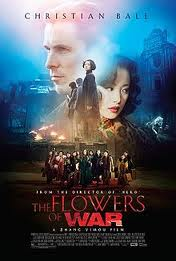
The Flowers of War (2011) is directed by Zhang Yimou, China's best-known director (Ju Dou, Raise the Red Lantern) and based on the novel 13 Flowers of Nanjing by Geling Yan. It is the most expensive movie made in China and paves the way for large international audiences. It stars Christian Bale and Nanjing native Ni Ni (Yimou's latest "Mou" girl). A beautiful soundtrack backs an impressive film about schoolgirls and prostitutes seeking safe haven in a Nanjing cathedral at the onset of the Nanking Massacre in 1937, under the protection of a mortician turned priest.
Tuesday, April 2, 2013
Beasts of No Nation by Uzodinma Iweala
"Uzo" Iweala (U-zod-din-ma EE-wall-a) hails from a well-heeled Nigerian family, part of the vast diaspora situated in the U.S. His father is a surgeon, and mother was Nigeria's Minister of Finance. He wrote this story as a Harvard undergrad. His grasp of native language is phenomenal. The concept was born when attending a speaking engagement at Harvard by China Keitetsi, a young woman forced to fight in the Ugandan Civil War. Most readers will imagine these lives as typical of the boy-soldiers of Sierra Leone.
As I began this magical little book, the lexicon of the 9-year old Agu struck me as a very powerful medium for telling the story of a boy forced to become a soldier, a killing machine. His voice is "unliterary, yet poetic" (Baker, NYT 12/4/05). The story is unimaginable without this voice.
It has precedence in Martin Amis' short story "What Happened to Me on My Holiday" in the collection Heavy Water. Amis' story takes place in "Horzeleej Band" (Horseleech Pond, South of Wellfleet) and is narrated in an argot simulating his actual son, Louis, mourning the death of his step-brother. The book is replete with onomatopoeia words like "TAKA TAKA TAKA," (p. 79) the sound of machine gun fire. I am reminded of the Swahili term for motorcycle "piki piki piki," echoing the gentle sounds of a Honda 125 cc bike in the Tanzania bush.
The atrocities these boys are forced to commit are brutal. "You are not my mother, I am saying to the girl's mother and when I am raising my knife high above my head. I am liking the sound of knife chopping KPWUDA KPWUDA on her head and how the blood is just splashing on my hand and my face and my feets. I am chopping and chopping and chopping until I am looking up and it is dark" (p. 51). His commander is a pederast "Commandant is touching me and bringing my head to where he is standing at attention" (p. 84). There's more: "he was telling me to kneel and then he was entering inside of me the way the man goat is sometimes mistaking other man goat for woman goat and going inside of them" (p. 85). The man-boys are starving: "Everyone here is doing zero zero one. I am not knowing what this is meaning before I am soldier, but now I am knowing that it means no breakfast, no lunch, only dinner" (p. 90). Agu laments childhood lost: "I am knowing I am no more child so if this war is ending I cannot be going back to doing child thing" (p. 93).
Thursday, March 28, 2013
I Do Not Come to You by Chance by Adaobi Tricia Nwaubani
This is a page turner of a book and Nwaubani in I Do Not Come to You by Chance (2010) has been able to master a well written novel with great comedic style through caricature, something I have not seen in Nigerian authors. Not unlike Noo Saro-Wiwa, her father was an activist, although Chukwuma Hope Nwaubani never paid with his life. She was born in Enugu, grew up in Umuahia and has stayed in Nigeria, graduating from the Univ. of Ibadan, now living in Lagos after time spent in Abuja. Got that? The story takes place in Abia State and involves the Igbo tribe ("the niggers of Nigeria," pp. 234, 254) as does much Nigerian fiction.
The title was inspired by Ecclesiastes 9:11. "I returned, and saw under the sun,that the race is not to the swift, nor the battle to the strong, neither yet bread to the wise, nor yet riches to men of understanding, nor yet favour to men of skill; but time and chance happeneth to them all." The author found the titular line from a '419' letter (p. 178) to an unsuspecting foreigner or "mugu" (p. 177).
It is interesting that this young woman writes a novel through the eyes of a young man, Kingsley Onyeaghalanwanneya Ibe. He is an "opara" (pp. 15, 182, 376) the eldest son. The author's name Adaobi means first daughter. He loses his idealism and joins his Uncle Boniface aka Cash Daddy in a 419 Nigerian Letter scam. The mugu is lured into various fees to be paid before he receives the big money, be it hidden money in a Swiss bank account or whatever.
Ikhide Ikheloa (www.thenewblackmagazine.com) opines that the book 'reeks of rampant anti-intellectualism. Cash Daddy chides Kingsley for his bookish aspirations.
The book is loaded with hilarity. We learn that the National Electric Power Authority is best called Never Expect Power Always (p. 64). "it felt as if 2,2,4-trimethylpentane had been pumped into my heart and set alight with a stick of match" (p.95) refers to the octane isomer used in octane rating. Ben & Jerry's ice cream seems a staple of the 419ers (p. 145). Kings' father relates the story of how the tortoise broke his back (p. 158), yet this fable already appeared in Adiche's Purple Hibiscus (2003), oops ! Kings notes that as Cash Daddy emerges from the shower "his five limbs were thick and long" (214).
Subscribe to:
Posts (Atom)